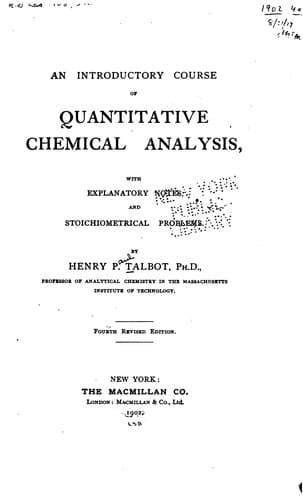
An Introductory Course of Quantitative Chemical Analysis: With Explanatory NotesTalbot, Henry Paul
Science
An Introductory Course of Quantitative Chemical Analysis: With Explanatory Notes
Talbot, Henry Paul
Chemistry, Analytic -- Quantitative
When possible, substances are selected which separate in crystalline
form, since such substances are less likely to clog the pores of
filter paper and can be most quickly washed. In order to increase the
size of the crystals, which further promotes filtration and washing,
it is often desirable to allow a precipitate to remain for some time
in contact with the solution from which it has separated. The solution
is often kept warm during this period of "digestion." The small
crystals gradually disappear and the larger crystals increase in size,
probably as the result of the force known as surface tension, which
tends to reduce the surface of a given mass of material to a minimum,
combined with a very slightly greater solubility of small crystals as
compared with the larger ones.
Amorphous substances, such as ferric hydroxide, aluminium hydroxide,
or silicic acid, separate in a gelatinous form and are relatively
difficult to filter and wash. Substances of this class also exhibit
a tendency to form, with pure water, what are known as colloidal
solutions. To prevent this as far as possible, they are washed with
solutions of volatile salts, as will be described in some of the
following procedures.
In all precipitations the reagent should be added slowly, with
constant stirring, and should be hot when circumstances permit.
The slow addition is less likely to occasion contamination of the
precipitate by the inclosure of other substances which may be in the
solution, or of the reagent itself.
FUNNELS AND FILTERS
Filtration in analytical processes is most commonly effected through
paper filters. In special cases these may be advantageously replaced
by an asbestos filter in a perforated porcelain or platinum crucible,
commonly known, from its originator, as a "Gooch filter." The
operation and use of a filter of this type is described on page 103.
Porous crucibles of a material known as alundum may also be employed
to advantage in special cases.
The glass funnels selected for use with paper filters should have an
angle as near 60° as possible, and a narrow stem about six inches in
length. The filters employed should be washed filters, i.e., those
which have been treated with hydrochloric and hydrofluoric acids, and
which on incineration leave a very small and definitely known weight
of ash, generally about .00003 gram. Such filters are readily
obtainable on the market.
The filter should be carefully folded to fit the funnel according to
either of the two well-established methods described in the Appendix.
It should always be placed so that the upper edge of the paper
is about one fourth inch below the top of the funnel. Under no
circumstances should the filter extend above the edge of the funnel,
as it is then utterly impossible to effect complete washing.
Public-domain text, read in full here on John Shaqi.
Reviews
Reviews
No reviews yet
Be the first to share your thoughts on this work.
Elsewhere in the archive
Join the Discussion
Join the discussion
Sign in to leave a comment or review.
Sign InorCreate an account