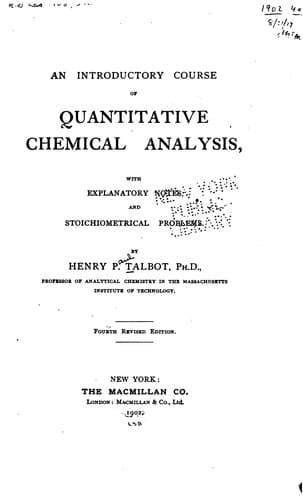
An Introductory Course of Quantitative Chemical Analysis: With Explanatory NotesTalbot, Henry Paul
Science
An Introductory Course of Quantitative Chemical Analysis: With Explanatory Notes
Talbot, Henry Paul
Chemistry, Analytic -- Quantitative
A precipitate should never completely fill a filter. The wash-water
should be applied at the top of the filter, above the precipitate.
It may be shown mathematically that the washing is most !rapidly!
accomplished by filling the filter well to the top with wash-water
each time, and allowing it to drain completely after each addition;
but that when a precipitate is to be washed with the !least possible
volume! of liquid the latter should be applied in repeated !small!
quantities.
Gelatinous precipitates should not be allowed to dry before complete
removal of foreign matter is effected. They are likely to shrink and
crack, and subsequent additions of wash-water pass through these
channels only.
All filtrates and wash-waters without exception must be properly
tested. !This lies at the foundation of accurate work!, and the
student should clearly understand that it is only by the invariable
application of this rule that assurance of ultimate reliability can
be secured. Every original filtrate must be tested to prove complete
precipitation of the compound to be separated, and the wash-waters
must also be tested to assure complete removal of foreign material. In
testing the latter, the amount first taken should be but a few
drops if the filtrate contains material which is to be subsequently
determined. When, however, the washing of the filter and precipitate
is nearly completed the amount should be increased, and for the final
test not less than 3 cc. should be used.
It is impossible to trust to one's judgment with regard to the washing
of precipitates; the washings from !each precipitate! of a series
simultaneously treated must be tested, since the rate of washing will
often differ materially under apparently similar conditions, !No
exception can ever be made to this rule!.
The habit of placing a clean common filter paper under the receiving
beaker during filtration is one to be commended. On this paper a
record of the number of washings can very well be made as the portions
of wash-water are added.
It is an excellent practice, when possible, to retain filtrates and
precipitates until the completion of an analysis, in order that, in
case of question, they may be examined to discover sources of error.
For the complete removal of precipitates from containing vessels, it
is often necessary to rub the sides of these vessels to loosen the
adhering particles. This can best be done by slipping over the end of
a stirring rod a soft rubber device sometimes called a "policeman."
DESICCATORS
Desiccators should be filled with fused, anhydrous calcium chloride,
over which is placed a clay triangle, or an iron triangle covered with
silica tubes, to support the crucible or other utensils. The cover of
the desiccator should be made air-tight by the use of a thin coating
of vaseline.
Public-domain text, read in full here on John Shaqi.
Reviews
Reviews
No reviews yet
Be the first to share your thoughts on this work.
Elsewhere in the archive
Join the Discussion
Join the discussion
Sign in to leave a comment or review.
Sign InorCreate an account