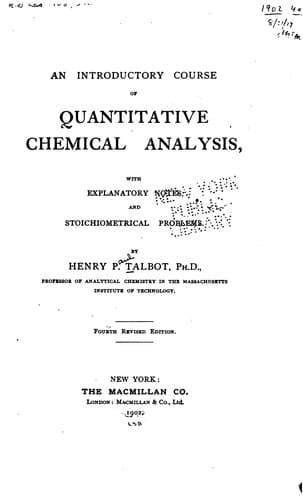
An Introductory Course of Quantitative Chemical Analysis: With Explanatory NotesTalbot, Henry Paul
Science
An Introductory Course of Quantitative Chemical Analysis: With Explanatory Notes
Talbot, Henry Paul
Chemistry, Analytic -- Quantitative
To test the efficiency of the filter, fill it with distilled water.
This water should soon fill the stem completely, forming a continuous
column of liquid which, by its hydrostatic pressure, produces a gentle
suction, thus materially promoting the rapidity of filtration. Unless
the filter allows free passage of water under these conditions, it is
likely to give much trouble when a precipitate is placed upon it.
The use of a suction pump to promote filtration is rarely altogether
advantageous in quantitative analysis, if paper filters are employed.
The tendency of the filter to break, unless the point of the filter
paper is supported by a perforated porcelain cone or a small "hardened
filter" of parchment, and the tendency of the precipitates to pass
through the pores of the filter, more than compensate for the possible
gain in time. On the other hand, filtration by suction may be useful
in the case of precipitates which do not require ignition before
weighing, or in the case of precipitates which are to be discarded
without weighing. This is best accomplished with the aid of the
special apparatus called a Gooch filter referred to above.
FILTRATION AND WASHING OF PRECIPITATES
Solutions should be filtered while hot, as far as possible, since
the passage of a liquid through the pores of a filter is retarded by
friction, and this, for water at 100°C., is less than one sixth of the
resistance at 0°C.
When the filtrate is received in a beaker, the stem of the funnel
should touch the side of the receiving vessel to avoid loss by
spattering. Neglect of this precaution is a frequent source of error.
The vessels which contain the initial filtrate should !always! be
replaced by clean ones, properly labeled, before the washing of a
precipitate begins. In many instances a finely divided precipitate
which shows no tendency to pass through the filter at first, while the
solution is relatively dense, appears at once in the washings. Under
such conditions the advantages accruing from the removal of the first
filtrate are obvious, both as regards the diminished volume requiring
refiltration, and also the smaller number of washings subsequently
required.
Much time may often be saved by washing precipitates by decantation,
i.e., by pouring over them, while still in the original vessel,
considerable volumes of wash-water and allowing them to settle. The
supernatant, clear wash-water is then decanted through the filter,
so far as practicable without disturbing the precipitate, and a new
portion of wash-water is added. This procedure can be employed to
special advantage with gelatinous precipitates, which fill up the
pores of the filter paper. As the medium from which the precipitate
is to settle becomes less dense it subsides less readily, and it
ultimately becomes necessary to transfer it to the filter and complete
the washing there.
Public-domain text, read in full here on John Shaqi.
Reviews
Reviews
No reviews yet
Be the first to share your thoughts on this work.
Elsewhere in the archive
Join the Discussion
Join the discussion
Sign in to leave a comment or review.
Sign InorCreate an account