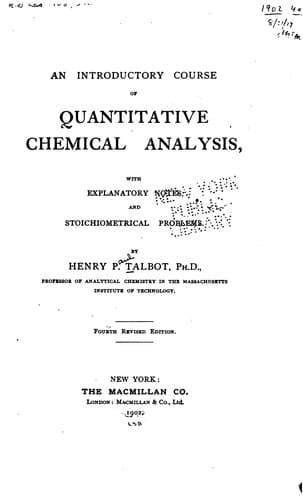
An Introductory Course of Quantitative Chemical Analysis: With Explanatory NotesTalbot, Henry Paul
Science
An Introductory Course of Quantitative Chemical Analysis: With Explanatory Notes
Talbot, Henry Paul
Chemistry, Analytic -- Quantitative
The perfectly dry filter is then opened over a circular piece of
clean, smooth, glazed paper about six inches in diameter, placed upon
a larger piece about twelve inches in diameter. The precipitate is
removed from the filter as completely as possible by rubbing the sides
gently together, or by scraping them cautiously with a feather which
has been cut close to the quill and is slightly stiff (Note 1). In
either case, care must be taken not to rub off any considerable
quantity of the paper, nor to lose silver chloride in the form of
dust. Cover the precipitate on the glazed paper with a watch-glass to
prevent loss of fine particles and to protect it from dust from the
air. Fold the filter paper carefully, roll it into a small cone, and
wind loosely around !the top! a piece of small platinum wire (Note 2).
Hold the filter by the wire over a small porcelain crucible (which has
been cleaned, ignited, cooled in a desiccator, and weighed), ignite
it, and allow the ash to fall into the crucible. Place the crucible
upon a clean clay triangle, on its side, and ignite, with a low
flame well at its base, until all the carbon of the filter has been
consumed. Allow the crucible to cool, add two drops of concentrated
nitric acid and one drop of concentrated hydrochloric acid, and heat
!very cautiously!, to avoid spattering, until the acids have been
expelled; then transfer the main portion of the precipitate from the
glazed paper to the cooled crucible, placing the latter on the larger
piece of glazed paper and brushing the precipitate from the
smaller piece into it, sweeping off all particles belonging to the
determination.
Moisten the precipitate with two drops of concentrated nitric acid and
one drop of concentrated hydrochloric acid, and again heat with great
caution until the acids are expelled and the precipitate is white,
when the temperature is slowly raised until the silver chloride just
begins to fuse at the edges (Note 3). The crucible is then cooled in a
desiccator and weighed, after which the heating (without the addition
of acids) is repeated, and it is again weighed. This must be continued
until the weight is constant within 0.0003 gram in two consecutive
weighings. Deduct the weight of the crucible, and calculate the
percentage of chlorine in the sample of sodium chloride taken for
analysis.
Public-domain text, read in full here on John Shaqi.
Reviews
Reviews
No reviews yet
Be the first to share your thoughts on this work.
Elsewhere in the archive
Join the Discussion
Join the discussion
Sign in to leave a comment or review.
Sign InorCreate an account