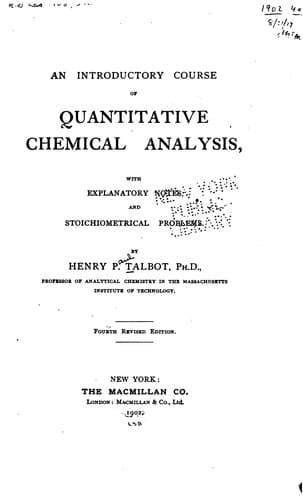
An Introductory Course of Quantitative Chemical Analysis: With Explanatory NotesTalbot, Henry Paul
Science
An Introductory Course of Quantitative Chemical Analysis: With Explanatory Notes
Talbot, Henry Paul
Chemistry, Analytic -- Quantitative
[Note 1: The separation of the silver chloride from the filter is
essential, since the burning carbon of the paper would reduce a
considerable quantity of the precipitate to metallic silver, and its
complete reconversion to the chloride within the crucible, by means of
acids, would be accompanied by some difficulty. The small amount of
silver reduced from the chloride adhering to the filter paper after
separating the bulk of the precipitate, and igniting the paper
as prescribed, can be dissolved in nitric acid, and completely
reconverted to chloride by hydrochloric acid. The subsequent addition
of the two acids to the main portion of the precipitate restores the
chlorine to any chloride which may have been partially reduced by the
sunlight. The excess of the acids is volatilized by heating.]
[Note 2: The platinum wire is wrapped around the top of the filter
during its incineration to avoid contact with any reduced silver from
the reduction of the precipitate. If the wire were placed nearer the
apex, such contact could hardly be avoided.]
[Note 3: Silver chloride should not be heated to complete fusion,
since a slight loss by volatilization is possible at high
temperatures. The temperature of fusion is not always sufficient
to destroy filter shreds; hence these should not be allowed to
contaminate the precipitate.]
DETERMINATION OF IRON AND OF SULPHUR IN FERROUS AMMONIUM SULPHATE,
FESO_{4}.(NH_{4})_{2}SO_{4}.6H_{2}O
DETERMINATION OF IRON
PROCEDURE.--Weigh out into beakers (200-250 cc.) two portions of the
sample (Note 1) of about 1 gram each and dissolve these in 50 cc. of
water, to which 1 cc. of dilute hydrochloric acid (sp. gr. 1.12) has
been added (Note 2). Heat the solution to boiling, and while at the
boiling point add concentrated nitric acid (sp. gr. 1.42), !drop by
drop! (noting the volume used), until the brown coloration, which
appears after the addition of a part of the nitric acid, gives place
to a yellow or red (Note 3). Avoid a large excess of nitric acid, but
be sure that the action is complete. Pour this solution cautiously
into about 200 cc. of water, containing a slight excess of ammonia.
Calculate for this purpose the amount of aqueous ammonia required to
neutralize the hydrochloric and nitric acids added (see Appendix for
data), and also to precipitate the iron as ferric hydroxide from the
weight of the ferrous ammonium sulphate taken for analysis, assuming
it to be pure (Note 4). The volume thus calculated will be in excess
of that actually required for precipitation, since the acids are in
part consumed in the oxidation process, or are volatilized. Heat the
solution to boiling, and allow the precipitated ferric hydroxide to
settle. Decant the clear liquid through a washed filter (9 cm.),
keeping as much of the precipitate in the beaker as possible. Wash
twice by decantation with 100 cc. of hot water. Reserve the filtrate.
Dissolve the iron from the filter with hot, dilute hydrochloric acid
(sp. gr.
Public-domain text, read in full here on John Shaqi.
Reviews
Reviews
No reviews yet
Be the first to share your thoughts on this work.
Elsewhere in the archive
Join the Discussion
Join the discussion
Sign in to leave a comment or review.
Sign InorCreate an account