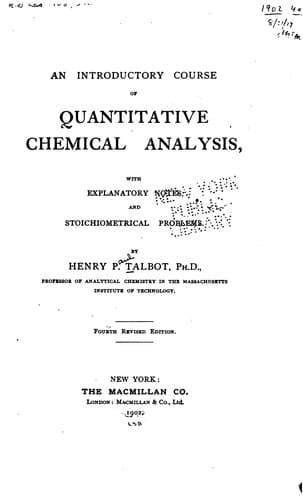
An Introductory Course of Quantitative Chemical Analysis: With Explanatory NotesTalbot, Henry Paul
Science
An Introductory Course of Quantitative Chemical Analysis: With Explanatory Notes
Talbot, Henry Paul
Chemistry, Analytic -- Quantitative
[Note 4: The ferric hydroxide precipitate tends to carry down some
sulphuric acid in the form of basic ferric sulphate. This tendency is
lessened if the solution of the iron is added to an excess of OH^{-}
ions from the ammonium hydroxide, since under these conditions
immediate and complete precipitation of the ferric hydroxide ensues.
A gradual neutralization with ammonia would result in the local
formation of a neutral solution within the liquid, and subsequent
deposition of a basic sulphate as a consequence of a local deficiency
of OH^{-} ions from the NH_{4}OH and a partial hydrolysis of the
ferric salt. Even with this precaution the entire absence of sulphates
from the first iron precipitate is not assured. It is, therefore,
redissolved and again thrown down by ammonia. The organic matter of
the filter paper may occasion a partial reduction of the iron during
solution, with consequent possibility of incomplete subsequent
precipitation with ammonia. The nitric acid is added to reoxidize this
iron.
To avoid errors arising from the solvent action of ammoniacal
liquids upon glass, the iron precipitate should be filtered without
unnecessary delay.]
[Note 5: The washings from the ferric hydroxide are acidified with
nitric acid, before testing with silver nitrate, to destroy the
ammonia which is a solvent of silver chloride.
The use of suction to promote filtration and washing is permissible,
though not prescribed. The precipitate should not be allowed to dry
during the washing.]
!Ignition of the Iron Precipitate!
Heat a platinum or porcelain crucible, cool it in a desiccator and
weigh, repeating until a constant weight is obtained.
Fold the top of the filter paper over the moist precipitate of ferric
hydroxide and transfer it cautiously to the crucible. Wipe the inside
of the funnel with a small fragment of washed filter paper, if
necessary, and place the paper in the crucible.
Incline the crucible on its side, on a triangle supported on a
ring-stand, and stand the cover on edge at the mouth of the crucible.
Place a burner below the front edge of the crucible, using a low flame
and protecting it from drafts of air by means of a chimney. The heat
from the burner is thus reflected into the crucible and dries
the precipitate without danger of loss as the result of a sudden
generation of steam within the mass of ferric hydroxide. As the drying
progresses the burner may be gradually moved toward the base of the
crucible and the flame increased until the paper of the filter begins
to char and finally to smoke, as the volatile matter is expelled. This
is known as "smoking off" a filter, and the temperature should not be
raised sufficiently high during this process to cause the paper to
ignite, as the air currents produced by the flame of the blazing paper
may carry away particles of the precipitate.
Public-domain text, read in full here on John Shaqi.
Reviews
Reviews
No reviews yet
Be the first to share your thoughts on this work.
Elsewhere in the archive
Join the Discussion
Join the discussion
Sign in to leave a comment or review.
Sign InorCreate an account