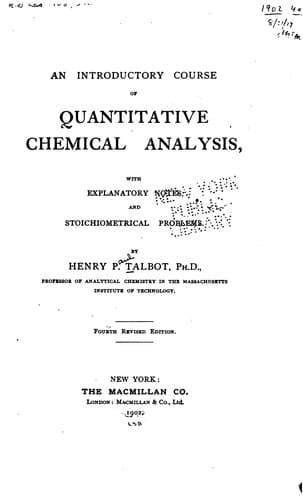
An Introductory Course of Quantitative Chemical Analysis: With Explanatory NotesTalbot, Henry Paul
Science
An Introductory Course of Quantitative Chemical Analysis: With Explanatory Notes
Talbot, Henry Paul
Chemistry, Analytic -- Quantitative
1.12), adding it in small portions, using as little as
possible and noting the volume used. Collect the solution in the
beaker in which precipitation took place. Add 1 cc. of nitric acid
(sp. gr. 1.42), boil for a few moments, and again pour into a
calculated excess of ammonia.
Wash the precipitate twice by decantation, and finally transfer it to
the original filter. Wash continuously with hot water until finally
3 cc. of the washings, acidified with nitric acid (Note 5), show
no evidences of the presence of chlorides when tested with silver
nitrate. The filtrate and washings are combined with those from the
first precipitation and treated for the determination of sulphur, as
prescribed on page 112.
[Note 1: If a selection of pure material for analysis is to be made,
crystals which are cloudy are to be avoided on account of loss of
water of crystallization; and also those which are red, indicating
the presence of ferric iron. If, on the other hand, the value of an
average sample of material is desired, it is preferable to grind the
whole together, mix thoroughly, and take a sample from the mixture for
analysis.]
[Note 2: When aqueous solutions of ferrous compounds are heated in the
air, oxidation of the Fe^{++} ions to Fe^{+++} ions readily occurs in
the absence of free acid. The H^{+} and OH^{-} ions from water are
involved in the oxidation process and the result is, in effect, the
formation of some ferric hydroxide which tends to separate. Moreover,
at the boiling temperature, the ferric sulphate produced by the
oxidation hydrolyzes in part with the formation of a basic ferric
sulphate, which also tends to separate from solution. The addition of
the hydrochloric acid prevents the formation of ferric hydroxide, and
so far reduces the ionization of the water that the hydrolysis of the
ferric sulphate is also prevented, and no precipitation occurs on
heating.]
[Note 3: The nitric acid, after attaining a moderate strength,
oxidizes the Fe^{++} ions to Fe^{+++} ions with the formation of an
intermediate nitroso-compound similar in character to that formed in
the "ring-test" for nitrates. The nitric oxide is driven out by heat,
and the solution then shows by its color the presence of ferric
compounds. A drop of the oxidized solution should be tested on
a watch-glass with potassium ferricyanide, to insure a complete
oxidation. This oxidation of the iron is necessary, since Fe^{++} ions
are not completely precipitated by ammonia.
The ionic changes which are involved in this oxidation are perhaps
most simply expressed by the equation
3Fe^{++} + NO_{3}^{-}+ 4H^{+} --> 3Fe^{+++} + 2H_{2}O + NO,
the H^{+} ions coming from the acid in the solution, in this case
either the nitric or the hydrochloric acid. The full equation on which
this is based may be written thus:
6FeSO_{4} + 2HNO_{3} + 6HCl --> 2Fe_{2}(SO_{4})_{3} + 2FeCl_{3} + 2NO
+ 4H_{2}O,
assuming that only enough nitric acid is added to complete the
oxidation.]
Public-domain text, read in full here on John Shaqi.
Reviews
Reviews
No reviews yet
Be the first to share your thoughts on this work.
Elsewhere in the archive
Join the Discussion
Join the discussion
Sign in to leave a comment or review.
Sign InorCreate an account