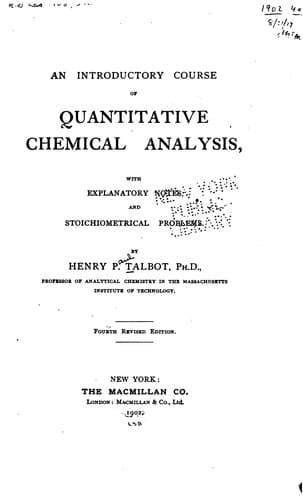
An Introductory Course of Quantitative Chemical Analysis: With Explanatory NotesTalbot, Henry Paul
Science
An Introductory Course of Quantitative Chemical Analysis: With Explanatory Notes
Talbot, Henry Paul
Chemistry, Analytic -- Quantitative
PROCEDURE.--Add to the combined filtrates from the ferric hydroxide
about 0.6 gram of anhydrous sodium carbonate; cover the beaker, and
then add dilute hydrochloric acid (sp. gr. 1.12) in moderate excess
and evaporate to dryness on the water bath. Add 10 cc. of concentrated
hydrochloric acid (sp. gr. 1.20) to the residue, and again evaporate
to dryness on the bath. Dissolve the residue in water, filter if not
clear, transfer to a 700 cc. beaker, dilute to about 400 cc., and
cautiously add hydrochloric acid until the solution shows a distinctly
acid reaction (Note 1). Heat the solution to boiling, and add !very
slowly! and with constant stirring, 20 cc. in excess of the calculated
amount of a hot barium chloride solution, containing about 20 grams
BaCl_{2}.2H_{2}O per liter (Notes 2 and 3). Continue the boiling for
about two minutes, allow the precipitate to settle, and decant the
liquid at the end of half an hour (Note 4). Replace the beaker
containing the original filtrate by a clean beaker, wash the
precipitated sulphate by decantation with hot water, and subsequently
upon the filter until it is freed from chlorides, testing the washings
as described in the determination of iron. The filter is then
transferred to a platinum or porcelain crucible and ignited, as
described above, until the weight is constant (Note 5). From the
weight of barium sulphate (BaSO_{4}) obtained, calculate the
percentage of sulphur (S) in the sample.
[Note 1: Barium sulphate is slightly soluble in hydrochloric acid,
even dilute, probably as a result of the reduction in the degree of
dissociation of sulphuric acid in the presence of the H^{+} ions of
the hydrochloric acid, and possibly because of the formation of a
complex anion made up of barium and chlorine; hence only the smallest
excess should be added over the amount required to acidify the
solution.]
[Note 2: The ionic changes involved in the precipitation of barium
sulphate are very simple:
Ba^{++} + SO_{4}^{--} --> [BaSO_{4}]
This case affords one of the best illustrations of the effect of an
excess of a precipitant in decreasing the solubility of a precipitate.
If the conditions are considered which exist at the moment when just
enough of the Ba^{++} ions have been added to correspond to the
SO_{4}^{--} ions in the solution, it will be seen that nearly all of
the barium sulphate has been precipitated, and that the small amount
which then remains in the solution which is in contact with the
precipitate must represent a saturated solution for the existing
temperature, and that this solution is comparable with a solution of
sugar to which more sugar has been added than will dissolve. It
should be borne in mind that the quantity of barium sulphate in
this !saturated solution is a constant quantity! for the existing
conditions. The dissolved barium sulphate, like any electrolyte, is
dissociated, and the equilibrium conditions may be expressed thus:
Public-domain text, read in full here on John Shaqi.
Reviews
Reviews
No reviews yet
Be the first to share your thoughts on this work.
Elsewhere in the archive
Join the Discussion
Join the discussion
Sign in to leave a comment or review.
Sign InorCreate an account