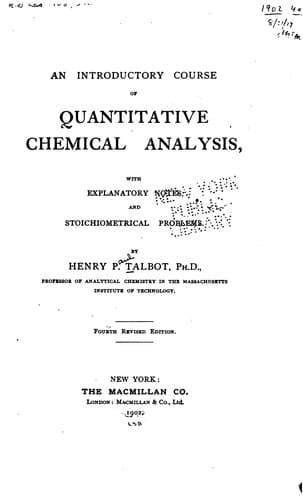
An Introductory Course of Quantitative Chemical Analysis: With Explanatory NotesTalbot, Henry Paul
Science
An Introductory Course of Quantitative Chemical Analysis: With Explanatory Notes
Talbot, Henry Paul
Chemistry, Analytic -- Quantitative
(!Conc'n Ba^{++} x Conc'n SO_{4}^{--})/(Conc'n BaSO_{4}) = Const.!,
and since !Conc'n BaSO_{4}! for the saturated solution has a constant
value (which is very small), it may be eliminated, when the expression
becomes !Conc'n Ba^{++} x Conc'n SO_{4}^{--} = Const.!, which is
the "solubility product" of BaSO_{4}. If, now, an excess of the
precipitant, a soluble barium salt, is added in the form of a
relatively concentrated solution (the slight change of volume of a few
cubic centimeters may be disregarded for the present discussion)
the concentration of the Ba^{++} ions is much increased, and as a
consequence the !Conc'n SO_{4}! must decrease in proportion if the
value of the expression is to remain constant, which is a requisite
condition if the law of mass action upon which our argument depends
holds true. In other words, SO_{4}^{--} ions must combine with some
of the added Ba^{++} ions to form [BaSO_{4}]; but it will be recalled
that the solution is already saturated with BaSO_{4}, and this freshly
formed quantity must, therefore, separate and add itself to the
precipitate. This is exactly what is desired in order to insure
more complete precipitation and greater accuracy, and leads to the
conclusion that the larger the excess of the precipitant added the
more successful the analysis; but a practical limit is placed upon
the quantity of the precipitant which may be properly added by other
conditions, as stated in the following note.]
[Note 3: Barium sulphate, in a larger measure than most compounds,
tends to carry down other substances which are present in the solution
from which it separates, even when these other substances are
relatively soluble, and including the barium chloride used as the
precipitant. This is also notably true in the case of nitrates and
chlorates of the alkalies, and of ferric compounds; and, since in this
analysis ammonium nitrate has resulted from the neutralization of the
excess of the nitric acid added to oxidize the iron, it is essential
that this should be destroyed by repeated evaporation with a
relatively large quantity of hydrochloric acid. During evaporation a
mutual decomposition of the two acids takes place, and the nitric acid
is finally decomposed and expelled by the excess of hydrochloric acid.
Iron is usually found in the precipitate of barium sulphate when
thrown down from hot solutions in the presence of ferric salts. This,
according to Kuster and Thiel (!Zeit. anorg. Chem.!, 22, 424), is due
to the formation of a complex ion (Fe(SO_{4})_{2}) which precipitates
with the Ba^{++} ion, while Richards (!Zeit. anorg. Chem.!, 23, 383)
ascribes it to hydrolytic action, which causes the formation of a
basic ferric complex which is occluded in the barium precipitate.
Whatever the character of the compound may be, it has been shown that
it loses sulphuric anhydride upon ignition, causing low results, even
though the precipitate contains iron.
Public-domain text, read in full here on John Shaqi.
Reviews
Reviews
No reviews yet
Be the first to share your thoughts on this work.
Elsewhere in the archive
Join the Discussion
Join the discussion
Sign in to leave a comment or review.
Sign InorCreate an account