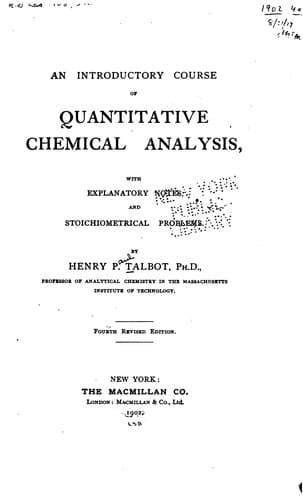
An Introductory Course of Quantitative Chemical Analysis: With Explanatory NotesTalbot, Henry Paul
Science
An Introductory Course of Quantitative Chemical Analysis: With Explanatory Notes
Talbot, Henry Paul
Chemistry, Analytic -- Quantitative
The contamination of the barium sulphate by iron is much less in the
presence of ferrous than ferric salts. If, therefore, the sulphur
alone were to be determined in the ferrous ammonium sulphate, the
precipitation by barium might be made directly from an aqueous
solution of the salt, which had been made slightly acid with
hydrochloric acid.]
[Note 4: The precipitation of the barium sulphate is probably complete
at the end of a half-hour, and the solution may safely be filtered at
the expiration of that time if it is desired to hasten the analysis.
As already noted, many precipitates of the general character of this
sulphate tend to grow more coarsely granular if digested for some time
with the liquid from which they have separated. It is therefore well
to allow the precipitate to stand in a warm place for several hours,
if practicable, to promote ease of filtration. The filtrate and
washings should always be carefully examined for minute quantities of
the sulphate which may pass through the pores of the filter. This is
best accomplished by imparting to the filtrate a gentle rotary motion,
when the sulphate, if present, will collect at the center of the
bottom of the beaker.]
[Note 5: A reduction of barium sulphate to the sulphide may very
readily be caused by the reducing action of the burning carbon of the
filter, and much care should be taken to prevent any considerable
reduction from this cause. Subsequent ignition, with ready access
of air, reconverts the sulphide to sulphate unless a considerable
reduction has occurred. In the latter case it is expedient to add one
or two drops of sulphuric acid and to heat cautiously until the excess
of acid is expelled.]
[Note 6: Barium sulphate requires about 400,000 parts of water for
its solution. It is not decomposed at a red heat but suffers loss,
probably of sulphur trioxide, at a temperature above 900°C.]
DETERMINATION OF SULPHUR IN BARIUM SULPHATE
Public-domain text, read in full here on John Shaqi.
Reviews
Reviews
No reviews yet
Be the first to share your thoughts on this work.
Elsewhere in the archive
Join the Discussion
Join the discussion
Sign in to leave a comment or review.
Sign InorCreate an account