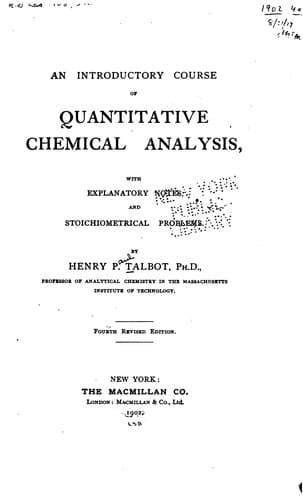
An Introductory Course of Quantitative Chemical Analysis: With Explanatory NotesTalbot, Henry Paul
Science
An Introductory Course of Quantitative Chemical Analysis: With Explanatory Notes
Talbot, Henry Paul
Chemistry, Analytic -- Quantitative
PROCEDURE.--Dissolve the precipitate of phosphomolybdate upon the
filter by pouring through it dilute aqueous ammonia (one volume of
dilute ammonia (sp. gr. 0.96) and three volumes of water, which
should be carefully measured), and receive the solution in the beaker
containing the bulk of the precipitate. The total volume of nitrate
and washings should not much exceed 100 cc. Acidify the solution with
dilute hydrochloric acid, and heat it nearly to boiling. Calculate the
volume of magnesium ammonium chloride solution ("magnesia mixture")
required to precipitate the phosphoric acid, assuming 40 per cent
P_{2}O_{5} in the apatite. Measure out about 5 cc. in excess of this
amount, and pour it into the acid solution. Then add slowly dilute
ammonium hydroxide (1 volume of strong ammonia (sp. gr. 0.90) and 9
volumes of water), stirring constantly until a precipitate forms. Then
add a volume of filtered, concentrated ammonia (sp. gr. 0.90) equal to
one third of the volume of liquid in the beaker (Note 1). Allow the
whole to cool. The precipitated magnesium ammonium phosphate should
then be definitely crystalline in appearance (Note 2). (If it is
desired to hasten the precipitation, the solution may be cooled, first
in cold and then in ice-water, and stirred !constantly! for half an
hour, when precipitation will usually be complete.)
Decant the clear liquid through a filter, and transfer the precipitate
to the filter, using as wash-water a mixture of one volume of
concentrated ammonia and three volumes of water. It is not necessary
to clean the beaker completely or to wash the precipitate thoroughly
at this point, as it is necessary to purify it by reprecipitation.
[Note 1: Magnesium ammonium phosphate is not a wholly insoluble
substance, even under the most favorable analytical conditions. It
is least soluble in a liquid containing one fourth of its volume of
concentrated aqueous ammonia (sp. gr. 0.90) and this proportion should
be carefully maintained as prescribed in the procedure. On account of
this slight solubility the volume of solutions should be kept as small
as possible and the amount of wash-water limited to that absolutely
required.
A large excess of the magnesium solution tends both to throw out
magnesium hydroxide (shown by a persistently flocculent precipitate)
and to cause the phosphate to carry down molybdic acid. The tendency
of the magnesium precipitate to carry down molybdic acid is also
increased if the solution is too concentrated. The volume should not
be less than 90 cc., nor more than 125 cc., at the time of the first
precipitation with the magnesia mixture.]
Public-domain text, read in full here on John Shaqi.
Reviews
Reviews
No reviews yet
Be the first to share your thoughts on this work.
Elsewhere in the archive
Join the Discussion
Join the discussion
Sign in to leave a comment or review.
Sign InorCreate an account