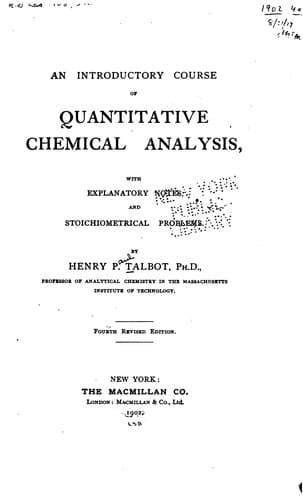
An Introductory Course of Quantitative Chemical Analysis: With Explanatory NotesTalbot, Henry Paul
Science
An Introductory Course of Quantitative Chemical Analysis: With Explanatory Notes
Talbot, Henry Paul
Chemistry, Analytic -- Quantitative
[Note 2: The magnesium ammonium phosphate should be perfectly
crystalline, and will be so if the directions are followed. The slow
addition of the reagent is essential, and the stirring not less so.
Stirring promotes the separation of the precipitate and the formation
of larger crystals, and may therefore be substituted for digestion in
the cold. The stirring-rod must not be allowed to scratch the glass,
as the crystals adhere to such scratches and are removed with
difficulty.]
REPRECIPITATION AND IGNITION OF MAGNESIUM AMMONIUM PHOSPHATE
A single precipitation of the magnesium compound in the presence of
molybdenum compounds rarely yields a pure product. The molybdenum can
be removed by solution of the precipitate in acid and precipitation
of the molybdenum by sulphureted hydrogen, after which the magnesium
precipitate may be again thrown down. It is usually more satisfactory
to dissolve the magnesium precipitate and reprecipitate the phosphate
as magnesium ammonium phosphate as described below.
PROCEDURE.--Dissolve the precipitate from the filter in a little
dilute hydrochloric acid (sp. gr. 1.12), allowing the acid solution to
run into the beaker in which the original precipitation was made (Note
1). Wash the filter with water until the wash-water shows no test for
chlorides, but avoid an unnecessary amount of wash-water. Add to
the solution 2 cc. (not more) of magnesia mixture, and then dilute
ammonium hydroxide solution (sp. gr. 0.96), drop by drop, with
constant stirring, until the liquid smells distinctly of ammonia. Stir
for a few moments and then add a volume of strong ammonia (sp. gr.
0.90), equal to one third of the volume of the solution. Allow the
solution to stand for some hours, and then filter off the magnesium
ammonium phosphate, which should be distinctly crystalline in
character. Wash the precipitate with dilute ammonia water, as
prescribed above, until, finally, 3 cc. of the washings, after
acidifying with nitric acid, show no evidence of chlorides. Test both
filtrates for complete precipitation by adding a few cubic centimeters
of magnesia mixture and allowing them to stand for some time.
Public-domain text, read in full here on John Shaqi.
Reviews
Reviews
No reviews yet
Be the first to share your thoughts on this work.
Elsewhere in the archive
Join the Discussion
Join the discussion
Sign in to leave a comment or review.
Sign InorCreate an account