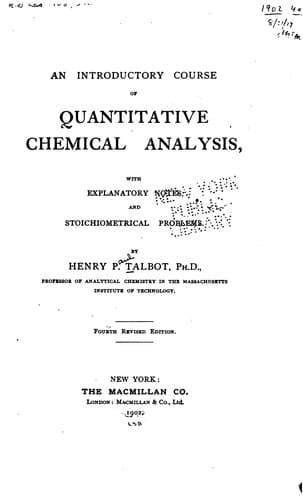
An Introductory Course of Quantitative Chemical Analysis: With Explanatory NotesTalbot, Henry Paul
Science
An Introductory Course of Quantitative Chemical Analysis: With Explanatory Notes
Talbot, Henry Paul
Chemistry, Analytic -- Quantitative
PROCEDURE.--To the filtrate from the insoluble residue add ammonium
hydroxide until the solution just smells distinctly of ammonia, but do
not add an excess. Then add 5 cc. of saturated bromine water (Note 1),
and boil for five minutes. If the smell of ammonia has disappeared,
again add ammonium hydroxide in slight excess, and 3 cc. of bromine
water, and heat again for a few minutes. Finally add 10 cc. of
ammonium chloride solution and keep the solution warm until it barely
smells of ammonia; then filter promptly (Note 2). Wash the filter
twice with hot water, then (after replacing the receiving beaker) pour
through it 25 cc. of hot, dilute hydrochloric acid (one volume dilute
HCl [sp. gr. 1.12] to five volumes water). A brown residue insoluble
in the acid may be allowed to remain on the filter. Wash the filter
five times with hot water, add to the filtrate ammonium hydroxide
and bromine water as described above, and repeat the precipitation.
Collect the precipitate on the filter already used, wash it free from
chlorides with hot water, and ignite and weigh as described for ferric
hydroxide on page 110. The residue after ignition consists of ferric
oxide, alumina, and mangano-manganic oxide (Mn_{3}O_{4}), if manganese
is present. These are commonly determined together (Note 3).
Calculate the percentage of the combined oxides in the limestone.
[Note 1: The addition of bromine water to the ammoniacal solutions
serves to oxidize any ferrous hydroxide to ferric hydroxide and to
precipitate manganese as MnO(OH)_{2}. The solution must contain not
more than a bare excess of hydroxyl ions (ammonium hydroxide) when it
is filtered, on account of the tendency of the aluminium hydroxide to
redissolve.
The solution should not be strongly ammoniacal when the bromine is
added, as strong ammonia reacts with the bromine, with the evolution
of nitrogen.]
[Note 2: The precipitate produced by ammonium hydroxide and bromine
should be filtered off promptly, since the alkaline solution absorbs
carbon dioxide from the air, with consequent partial precipitation
of the calcium as carbonate. This is possible even under the most
favorable conditions, and for this reason the iron precipitate is
redissolved and again precipitated to free it from calcium. When the
precipitate is small, this reprecipitation may be omitted.]
[Note 3: In the absence of significant amounts of manganese the iron
and aluminium may be separately determined by fusion of the mixed
ignited precipitate, after weighing, with about ten times its weight
of acid potassium sulphate, solution of the cold fused mass in water,
and volumetric determination of the iron, as described on page 66.
The aluminium is then determined by difference, after subtracting the
weight of ferric oxide corresponding to the amount of iron found.
Public-domain text, read in full here on John Shaqi.
Reviews
Reviews
No reviews yet
Be the first to share your thoughts on this work.
Elsewhere in the archive
Join the Discussion
Join the discussion
Sign in to leave a comment or review.
Sign InorCreate an account