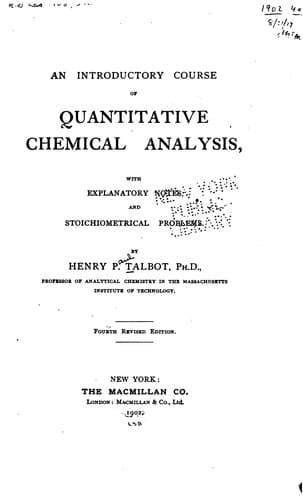
An Introductory Course of Quantitative Chemical Analysis: With Explanatory NotesTalbot, Henry Paul
Science
An Introductory Course of Quantitative Chemical Analysis: With Explanatory Notes
Talbot, Henry Paul
Chemistry, Analytic -- Quantitative
PROCEDURE.--Weigh out two portions of the original powdered sample
(not the dried sample), of about 5 grams each, into 250 cc.
casseroles, and cover each with a watch-glass (Note 1). Pour over the
powder 25 cc. of water, and then add 50 cc. of dilute hydrochloric
acid (sp. gr. 1.12) in small portions, warming gently, until nothing
further appears to dissolve (Note 2). Evaporate to dryness on the
water bath. Pour over the residue a mixture of 5 cc. of water and
5 cc. of concentrated hydrochloric acid (sp. gr. 1.2) and again
evaporate to dryness, and finally heat for at least an hour at
a temperature of 110°C. Pour over this residue 50 cc. of dilute
hydrochloric acid (one volume acid (sp. gr. 1.12) to five volumes
water), and boil for about five minutes; then filter and wash twice
with the dilute hydrochloric acid, and then with hot water until
free from chlorides. Transfer the filter and contents to a porcelain
crucible, dry carefully over a low flame, and ignite to constant
weight. The residue represents the insoluble matter and the silica
from any soluble silicates (Note 3).
Calculate the combined percentage of these in the limestone.
[Note 1: The relatively large weight (5 grams) taken for analysis
insures greater accuracy in the determination of the ingredients which
are present in small proportions, and is also more likely to be a
representative sample of the material analyzed.]
[Note 2: It is plain that the amount of the insoluble residue and also
its character will often depend upon the strength of acid used for
solution of the limestone. It cannot, therefore, be regarded as
representing any well-defined constituent, and its determination is
essentially empirical.]
[Note 3: It is probable that some of the silicates present are wholly
or partly decomposed by the acid, and the soluble silicic acid must
be converted by evaporation to dryness, and heating, into white,
insoluble silica. This change is not complete after one evaporation.
The heating at a temperature somewhat higher than that of the water
bath for a short time tends to leave the silica in the form of a
powder, which promotes subsequent filtration. The siliceous residue
is washed first with dilute acid to prevent hydrolytic changes, which
would result in the formation of appreciable quantities of insoluble
basic iron or aluminium salts on the filter when washing with hot
water.
If it is desired to determine the percentage of silica separately, the
ignited residue should be mixed in a platinum crucible with about six
times its weight of anhydrous sodium carbonate, and the procedure
given on page 151 should be followed. The filtrate from the silica is
then added to the main filtrate from the insoluble residue.]
DETERMINATION OF FERRIC OXIDE AND ALUMINIUM OXIDE (WITH MANGANESE)
Public-domain text, read in full here on John Shaqi.
Reviews
Reviews
No reviews yet
Be the first to share your thoughts on this work.
Elsewhere in the archive
Join the Discussion
Join the discussion
Sign in to leave a comment or review.
Sign InorCreate an account