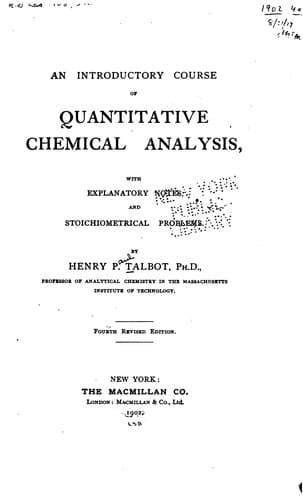
An Introductory Course of Quantitative Chemical Analysis: With Explanatory NotesTalbot, Henry Paul
Science
An Introductory Course of Quantitative Chemical Analysis: With Explanatory Notes
Talbot, Henry Paul
Chemistry, Analytic -- Quantitative
Redissolve the calcium oxalate in the beaker with warm hydrochloric
acid, pouring the acid through the filter. Wash the filter five times
with water, and finally pour through it aqueous ammonia. Dilute the
solution to 250 cc., bring to boiling, and add 1 cc. ammonium oxalate
solution (Note 5) and ammonia in slight excess; boil for two minutes,
and set aside for a half-hour. Filter off the calcium oxalate upon the
filter first used, and wash free from chlorides. The filtrate should
be made barely acid with hydrochloric acid and combined with the
filtrate from the first precipitation. Begin at once the evaporation
of the solutions for the determination of magnesium as described
below.
The precipitate of calcium oxalate may be converted into calcium oxide
by ignition without previous drying. After burning the filter, it may
be ignited for three quarters of an hour in a platinum crucible at
the highest heat of the Bunsen or Tirrill burner, and finally for ten
minutes at the blast lamp (Note 6). Repeat the heating over the blast
lamp until the weight is constant. As the calcium oxide absorbs
moisture from the air, it must (after cooling) be weighed as rapidly
as possible.
The precipitate may, if preferred, be placed in a weighted porcelain
crucible. After burning off the filter and heating for ten minutes the
calcium precipitate may be converted into calcium sulphate by placing
2 cc. of dilute sulphuric acid in the crucible (cold), heating the
covered crucible very cautiously over a low flame to drive off the
excess of acid, and finally at redness to constant weight (Note 7).
From the weight of the oxide or sulphate, calculate the percentage of
the calcium (Ca) in the limestone, remembering that only one fifth of
the total solution is used for this determination.
[Note 1: If the calcium were precipitated from the entire solution,
the quantity of the precipitate would be greater than could be
properly treated. The solution is, therefore, diluted to a definite
volume (500 cc.), and exactly one fifth (100 cc.) is measured off in a
graduated flask or by means of a pipette.]
[Note 2: The filtrate from the calcium oxalate should be made slightly
acid immediately after filtration, in order to avoid the solvent
action of the alkaline liquid upon the glass.]
Public-domain text, read in full here on John Shaqi.
Reviews
Reviews
No reviews yet
Be the first to share your thoughts on this work.
Elsewhere in the archive
Join the Discussion
Join the discussion
Sign in to leave a comment or review.
Sign InorCreate an account