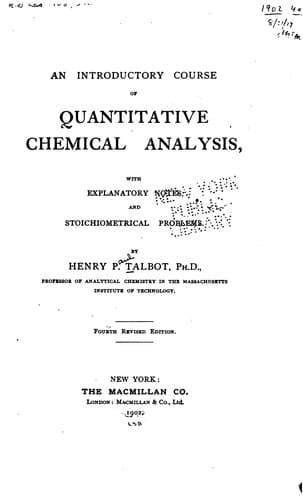
An Introductory Course of Quantitative Chemical Analysis: With Explanatory NotesTalbot, Henry Paul
Science
An Introductory Course of Quantitative Chemical Analysis: With Explanatory Notes
Talbot, Henry Paul
Chemistry, Analytic -- Quantitative
[Note 3: The accurate quantitative separation of calcium and magnesium
as oxalates requires considerable care. The calcium precipitate
usually carries down with it some magnesium, and this can best
be removed by redissolving the precipitate after filtration, and
reprecipitation in the presence of only the small amount of magnesium
which was included in the first precipitate. When, however, the
proportion of magnesium is not very large, the second precipitation of
the calcium can usually be avoided by precipitating it from a rather
dilute solution (800 cc. or so) and in the presence of a considerable
excess of the precipitant, that is, rather more than enough to convert
both the magnesium and calcium into oxalates.]
[Note 4: The ionic changes involved in the precipitation of calcium
as oxalate are exceedingly simple, and the principles discussed in
connection with the barium sulphate precipitation on page 113 also
apply here. The reaction is
C_{2}O_{4}^{--} + Ca^{++} --> [CaC_{2}O_{4}].
Calcium oxalate is nearly insoluble in water, and only very slightly
soluble in acetic acid, but is readily dissolved by the strong mineral
acids. This behavior with acids is explained by the fact that oxalic
acid is a stronger acid than acetic acid; when, therefore, the oxalate
is brought into contact with the latter there is almost no tendency to
diminish the concentration of C_{2}O_{4}^{--} ions by the formation of
an acid less dissociated than the acetic acid itself, and practically
no solvent action ensues. When a strong mineral acid is present,
however, the ionization of the oxalic acid is much reduced by the high
concentration of the H^{+} ions from the strong acid, the formation
of the undissociated acid lessens the concentration of the
C_{2}O_{4}^{--} ions in solution, more of the oxalate passes into
solution to re-establish equilibrium, and this process repeats itself
until all is dissolved.
The oxalate is immediately reprecipitated from such a solution on the
addition of OH^{-} ions, which, by uniting with the H^{+} ions of the
acids (both the mineral acid and the oxalic acid) to form water, leave
the Ca^{++} and C_{2}O_{4}^{--} ions in the solution to recombine to
form [CaC_{2}O_{4}], which is precipitated in the absence of the
H^{+} ions. It is well at this point to add a small excess of
C_{2}O_{4}^{--} ions in the form of ammonium oxalate to decrease the
solubility of the precipitate.
The oxalate precipitate consists mainly of CaC_{2}O_{4}.H_{2}O when
thrown down.]
[Note 5: The small quantity of ammonium oxalate solution is added
before the second precipitation of the calcium oxalate to insure
the presence of a slight excess of the reagent, which promotes the
separation of the calcium compound.]
[Note 6: On ignition the calcium oxalate loses carbon dioxide and
carbon monoxide, leaving calcium oxide:
CaC_{2}O_{4}.H_{2}O --> CaO + CO_{2} + CO + H_{2}O.
Public-domain text, read in full here on John Shaqi.
Reviews
Reviews
No reviews yet
Be the first to share your thoughts on this work.
Elsewhere in the archive
Join the Discussion
Join the discussion
Sign in to leave a comment or review.
Sign InorCreate an account