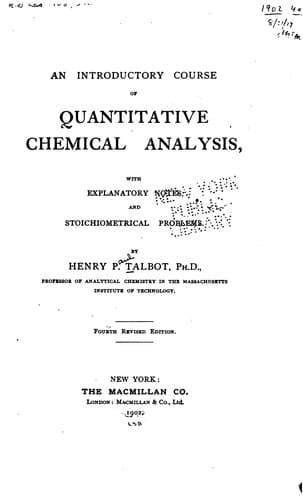
An Introductory Course of Quantitative Chemical Analysis: With Explanatory NotesTalbot, Henry Paul
Science
An Introductory Course of Quantitative Chemical Analysis: With Explanatory Notes
Talbot, Henry Paul
Chemistry, Analytic -- Quantitative
For small weights of the oxalate (0.6 gram or less) this reaction may
be brought about in a platinum crucible at the highest temperature of
a Tirrill burner, but it is well to ignite larger quantities than this
over the blast lamp until the weight is constant.]
[Note 7: The heat required to burn the filter, and that subsequently
applied as described, will convert most of the calcium oxalate to
calcium carbonate, which is changed to sulphate by the sulphuric acid.
The reactions involved are
CaC_{2}O_{4} --> CaCO_{3} + CO,
CaCO_{3} + H_{2}SO_{4} --> CaSO_{4} + H_{2}O + CO_{2}.
If a porcelain crucible is employed for ignition, this conversion to
sulphate is to be preferred, as a complete conversion to oxide is
difficult to accomplish.]
[Note 8: The determination of the calcium may be completed
volumetrically by washing the calcium oxalate precipitate from
the filter into dilute sulphuric acid, warming, and titrating
the liberated oxalic acid with a standard solution of potassium
permanganate as described on page 72. When a considerable number of
analyses are to be made, this procedure will save much of the time
otherwise required for ignition and weighing.]
DETERMINATION OF MAGNESIUM
PROCEDURE.--Evaporate the acidified filtrates from the calcium
precipitates until the salts begin to crystallize, but do !not!
evaporate to dryness (Note 1). Dilute the solution cautiously until
the salts are brought into solution, adding a little acid if the
solution has evaporated to very small volume. The solution should be
carefully examined at this point and must be filtered if a precipitate
has appeared. Heat the clear solution to boiling; remove the burner
and add 25 cc. of a solution of disodium phosphate. Then add slowly
dilute ammonia (1 volume strong ammonia (sp. gr. 0.90) and 9 volumes
water) as long as a precipitate continues to form. Finally, add a
volume of concentrated ammonia (sp. gr. 0.90) equal to one third of
the volume of the solution, and allow the whole to stand for about
twelve hours.
Decant the solution through a filter, wash it with dilute ammonia
water, proceeding as prescribed for the determination of phosphoric
anhydride on page 122, including; the reprecipitation (Note 2),
except that 3 cc. of disodium phosphate solution are added before the
reprecipitation of the magnesium ammonium phosphate instead of
the magnesia mixture there prescribed. From the weight of the
pyrophosphate, calculate the percentage of magnesium oxide (MgO) in
the sample of limestone. Remember that the pyrophosphate finally
obtained is from one fifth of the original sample.
[Note 1: The precipitation of the magnesium should be made in as small
volume as possible, and the ratio of ammonia to the total volume of
solution should be carefully provided for, on account of the relative
solubility of the magnesium ammonium phosphate. This matter has
been fully discussed in connection with the phosphoric anhydride
determination.]
Public-domain text, read in full here on John Shaqi.
Reviews
Reviews
No reviews yet
Be the first to share your thoughts on this work.
Elsewhere in the archive
Join the Discussion
Join the discussion
Sign in to leave a comment or review.
Sign InorCreate an account