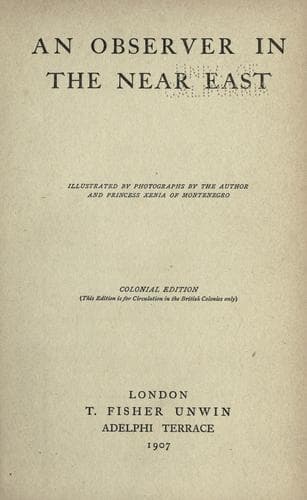
Balkan Peninsula -- Description and travel; Eastern question (Balkan)
and the Government, some fifteen years ago, was compelled to prohibit
the importation of geranium oil into the country. This measure was a
most wholesome one, and checked, to some extent, the free and open
importation of geranium, and saved many of the rose villages from
further corruption. However, a great deal of geranium oil is still
imported _sub rosâ_ into Bulgaria by unscrupulous jobbers and exporters,
and much of the otto-of-rose sold is largely adulterated with it.
Mr. Shipkoff, in course of his conversation with me when he showed me
over his distillery at Kazanlik, said, “As our principle is to export
only the genuine otto-of-rose, and sell only what we can guarantee as
absolutely pure, our task has been, and is, a most difficult one. With
the primitive system of distillation still in use in our country, it is
actually impossible for us to distil all the otto-of-rose we export, and
we still have to depend on our growers for the greater part of our
stock. When the means of transportation and communication improve, it
will then be possible to centralise the whole distillation in a few
places, and establish large steam distilleries, such as those in Grasse,
Cannes, and Leipzig. At present most of the rose-flowers are distilled
in the villages where they are grown, and by the growers themselves,
this method being by far the cheapest. Still, to guard ourselves from
all possible adulteration on the part of our suppliers, and at the same
time to be able to get as much otto-of-rose as possible of our own
distillation, we ourselves have to distil in all the principal places in
the eight rose counties of the rose district, and each year we increase
our own distillations.
“It is by virtue of this extensive distillation that we are able to
obtain pure otto. Besides this practical means, we have continually
experimented to discover various tests, whereby we can readily
distinguish the pure from the adulterated rose. It is quite impossible
simply from the sense of smell to always recognise an adulteration from
two to five per cent., and the following are the tests, which we possess
and use in conducting our business: the freezing-point test, the
specific gravity test, the density test, the spectrum test, the iodine
test, and the nitric acid test.
Public-domain text, read in full here on John Shaqi.
Reviews
Reviews
No reviews yet
Be the first to share your thoughts on this work.
Elsewhere in the archive
Join the Discussion
Join the discussion
Sign in to leave a comment or review.
Sign InorCreate an account