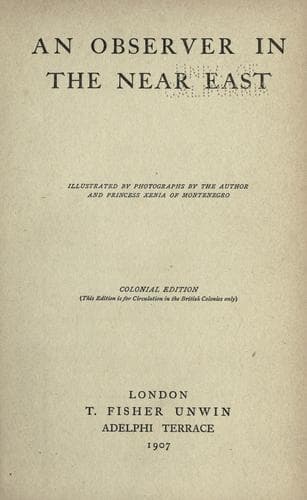
Balkan Peninsula -- Description and travel; Eastern question (Balkan)
The fact that everybody is armed gives the stranger an uncanny feeling.
The man who brings one’s coffee wears a perfect arsenal of weapons in
his sash, and one quickly acquires the habit of carrying a revolver
one’s self. Indeed, if you are wise, you will carry a good serviceable
weapon from the moment you enter the Balkans to the moment you quit
them. But if you approach the Albanian frontier, you will be at once
warned not to fire without just cause. A few shots is sufficient to
alarm the whole neighbourhood for many miles, and on hearing the alarm
every man seizes his rifle and flies to the rendezvous, fully equipped
and eager for the fight with those Albanian border tribes, of whom I
afterwards had the good fortune to be the guest.
I had already had a long chat with Prince Danilo, the Crown Prince of
Montenegro, whom I found a very smart and highly educated man, fully
alive to the political difficulties of the neighbouring states and the
necessity of Montenegro preserving her independence. He held very strong
views upon the terrible state of affairs in Macedonia, and gave me many
interesting details about his own country.
Having met him, and also his younger brother, Prince Mirko, I was
particularly anxious to make the acquaintance of their father, Prince
Nicholas, the ruler of the sturdy, warlike dwellers of the “Land of the
Black Mountain”—the principal and most striking figure in this
remarkable country, where peace and war walk ever hand-in-hand.
Since 1860, when his uncle, Prince Danilo, was assassinated, he has
ruled justly, if somewhat sternly, and has succeeded in raising his
nation from a state of semi-civilisation to the high place it now
occupies in the Eastern world. In 1888 he gave the country a Civil and
Criminal Code, and last year he granted a Constitution. Indeed, he has
done all in his power to induce his warriors to follow the arts of peace
without forgetting those of war.
At the hour appointed, the royal aide-de-camp called in a carriage and
drove me to the Palace,—a long, dark brown building of somewhat plain
exterior, as befits the home of a fighting race,—where I was received in
the great hall by half a dozen bowing servants in scarlet and gold. Here
I was met by the chamberlain, who conducted me up the grand staircase
and into the great audience-chamber, with its many fine paintings and
highly polished floor. Then, after a moment, the Prince—a brilliant
figure—entered, shook me by the hand, and welcomed me to Montenegro.
These formalities ended, His Royal Highness said in Italian, “Come, let
us go into yonder room. We shall be able to talk there more
comfortably.” And he led me into a smaller chamber, where he gave me a
seat at the table where he sat.
The afternoon was gloomy, and dusk was creeping on, therefore upon the
table a great antique silver candelabra had been set, and by its light I
was enabled to obtain a good view of the ruler of Crnagora, the “Land of
the Black Mountain.”
Public-domain text, read in full here on John Shaqi.
Reviews
Reviews
No reviews yet
Be the first to share your thoughts on this work.
Join the Discussion
Join the discussion
Sign in to leave a comment or review.
Sign InorCreate an account