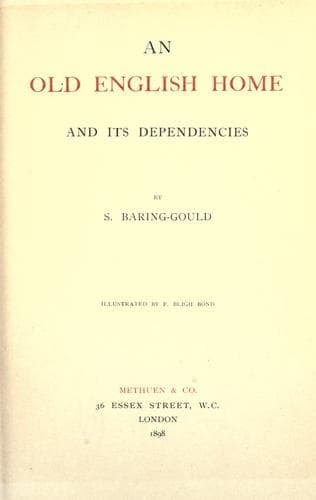
An Old English Home and Its DependenciesBaring-Gould, S. (Sabine)
History
An Old English Home and Its Dependencies
Baring-Gould, S. (Sabine)
England -- Social life and customs
Nearly every old house has its secret cupboard--usually in the wall.
Very often one may be found behind the panelling, and near the fire. In
my own house is one cut in granite, the stone on all sides, and is the
depth of my arm. I have little doubt that these warm, dry cupboards, so
secured that no mouse can make its way in, were for the preservation of
deeds. Others were for jewellery and plate. The custom of having secret
cupboards was continued after cupboards had become independent articles
of furniture, standing out in the room; but then they took the form
of secret compartments, not opened by keys, but by moving some part
of the moulding, or by pressure on some ornamental plate or piece of
inlaid wood or ivory.
It is said that everyone has his secret closet, and that in it everyone
has his skeleton. I do not know much about the cupboards of nowaday
folk, but when I think of those I knew in the olden times, it seems
to me that they were full of nothing other than sweets and spices, of
gold and gems; anyhow, such were the cupboards of our grandmothers, our
maiden aunts, and our great-grandmothers. And when we chance in some
secret compartment to light on a bundle of their letters, and look into
them, then it is just like the opening of their corner-cupboards, out
pours a sweet and spicy fragrance--that of the generous thoughts and
kind wishes of their dear old honest and God-fearing hearts.
[Illustration]
[Illustration: CEILINGS]
CHAPTER V.
When I was a small boy at King's College School, I boarded with one of
the masters, at a corner house in Queen's Square. There was a long room
in which we boarders--there were some five-and-twenty of us--had our
meals, and prepared lessons for the morrow in the evening, under the
supervision of an usher.
One day at tea, the usher having been summoned out of the room, we
boys essayed who could throw up his piece of bread and butter highest.
Mine went against the ceiling, and, the butter being unusually thick,
adhered.
I was in great alarm; there was no getting it down: it stuck, and
neither the usher nor the master, when he entered for prayers, observed
it.
During preparation of lessons, during prayers, my eyes reverted to the
piece of bread and butter. It remained unnoticed. That it was also
unobserved by the servants, who were supposed to clean the room, is not
perhaps matter of surprise.
The next day passed--still the bread and butter hung suspended--but
on the third day, during prayers, flop!--down it came in front of the
master, and left behind it a nasty, greasy stain on the ceiling.
"Whose piece of bread and butter is that?" asked the master, when Amen
had been said.
I had to confess, and was whipped.
That stain in the ceiling grew darker daily. The dust of the room
adhered to the butter. It was not effaced all the while I remained a
boarder, and I involuntarily every day, and frequently daily, looked at
it, to see how much deeper the tinge was that the patch acquired.
Public-domain text, read in full here on John Shaqi.
Reviews
Reviews
No reviews yet
Be the first to share your thoughts on this work.
Join the Discussion
Join the discussion
Sign in to leave a comment or review.
Sign InorCreate an account