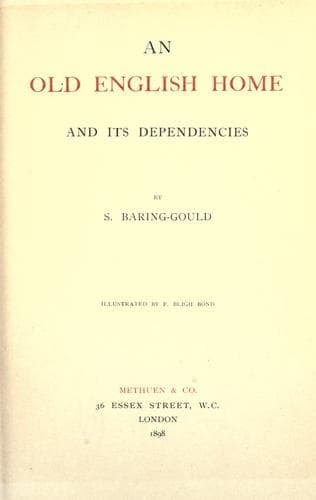
An Old English Home and Its DependenciesBaring-Gould, S. (Sabine)
History
An Old English Home and Its Dependencies
Baring-Gould, S. (Sabine)
England -- Social life and customs
"When we reached that part of the road to Nymet Rowland where their
field touched, we stopped, and in a moment some very angry, excited
women and children rushed out. I bade them be quiet and hear what I had
to say, and then told them that Lord ---- had asked me to bring these
comforts to the sick man, and that I was come to offer him my services
in his illness. They were instantly pacified and pleased, and begged
me to come to what they called the farm--a place with half a roof and
three walls. There were, I should think, three generations who lived
in this place. An old woman, not altogether illiterate, the wounded
man, his son, and his wife, and three or four children, and one or two
sisters of his, children of the old woman.
"I did not see anything that answered to a bed there; the man was
lying on two settles or sets of stools, with, I think, a blanket and
something which might, or might not, have been a mattress under him.
"In order to get his head under some certain shelter, it was resting on
a settle in the chimney, side by side with a fire; his body and legs
were on a settle in the room, if you could call a place with only three
walls and half a roof by that name, and I think that the floor was in
many places bare earth, and that the grass grew on it. The family were
all pleasant enough--rough but grateful--and I found that though the
doctor had thought amputation necessary, he now believed it might be
avoided--that the man had decided against it, but allowed the doctor
to continue to visit him. They were delighted with all I brought, and
begged me to return soon to them, which I promised to do, and to send
my children when I could not come. The old woman was a character, and
quoted Scripture--certainly at random--but with some shrewdness.
"After that time I and mine were always welcome. One of the married
sisters of the wounded Cheriton, who quite recovered, had bad
bronchitis, and some of my family visited her continually, and on one
occasion found her sitting on the thatched _bit_ of roof, against
the chimney, for 'change of air' in her convalescence. She was a big
powerful woman, who had on one occasion knocked down a policeman who
was taking her brother to Exeter gaol, and her mother, the old woman,
told me with pride that they had had to send a cart and three men to
take _her_ away. She afterwards married a labourer. The rest of the
family sold their property, and only the other day when I revisited
the place for the first time after many years, I found a smart house
erected in the place of the old 'Cheritons.' The women became great
beggars till the death of the old mother, and the dispersion on the
sale of the property.
"I remember once meeting the man Cheriton in the lane. He had decorated
the collar of his horse that he was driving with horrible entrails of a
sheep or pig. This was just the kind of savage ornament that would suit
them.
Public-domain text, read in full here on John Shaqi.
Reviews
Reviews
No reviews yet
Be the first to share your thoughts on this work.
Join the Discussion
Join the discussion
Sign in to leave a comment or review.
Sign InorCreate an account