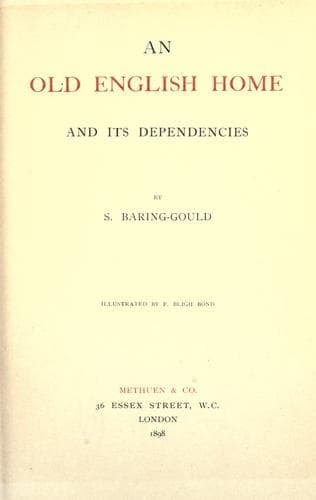
An Old English Home and Its DependenciesBaring-Gould, S. (Sabine)
History
An Old English Home and Its Dependencies
Baring-Gould, S. (Sabine)
England -- Social life and customs
Where there is private property there must be a demarcation, showing
its limits; and where there are crops on arable land, there, either
one or other of two alternatives must be adopted, the crops must be
protected by a hedge, dyke, or wall, from the incursions of the cattle,
or the cattle must be kept in confinement, to prevent their straying.
The former is the system adopted in England and in Westphalia, and the
latter is that general throughout the rest of Germany and France. The
term _mark_ has a curious history. Originally it signified the forest,
so called because of its gloom, whence our word _murk_. The mark or
forest bounded the clearing. Thence it came to signify the limit of
a claim made by a community to land held in common. Land bounding a
state or principality was then called also a mark or the marches, and
the official who watched it against incursions was the mark-graff, or
margrave, in French marquis, hence our marquess.
As the limit of a territory or a village, or a private claim had to be
given certain indications, when the wood had further retreated, stones
or posts were set up, and signs were cut on these to show that they
limited claims. The compound was in German entitled the Gemarkung, and
over every Gemarkung there was a villicus, bailiff, or _schultheiss_,
who regulated the affairs of the community.
In 1854 Dr. Konrad Maurer set all political economists agog by his
_Introduction to the History of the Mark, &c._ The book was not
intended as a hoax, but it succeeded in hoaxing pretty largely, and in
provoking considerable excitement.
His thesis was that among the Teutonic races the _Land belonged to the
People_, and that every householder had rights over the land, but that
the invasion of Feudalism altered everything, the lords then seized
on the land and converted the freeholders into serfs and villains.
His assertions were accepted as gospel, till disputed by Professor
Fustel de Coulanges in 1885 and 1889, who showed, by production of the
original texts, that Maurer had little or no evidence to sustain his
entire fabric. All the evidence goes the other way, to show that land,
directly men settled, became private property, but that the landlord
allowed his tenants to take wood from forests, turf from moors, and
have certain commons for pasturage, not as a right, but as a favour.
Maurer had started from a false premise. The _Mark_ or _ager_ never
meant common land, but the boundary of private estates.[8] In a word,
as far as evidence goes, his theory was the erection of a Fools'
Paradise for social and political reformers. Originally, when men were
nomads, the land belonged to nobody--but when tillage began, then at
once the marking out of fields became a necessity--and with the marking
came proprietorship.
Public-domain text, read in full here on John Shaqi.
Reviews
Reviews
No reviews yet
Be the first to share your thoughts on this work.
Elsewhere in the archive
Join the Discussion
Join the discussion
Sign in to leave a comment or review.
Sign InorCreate an account