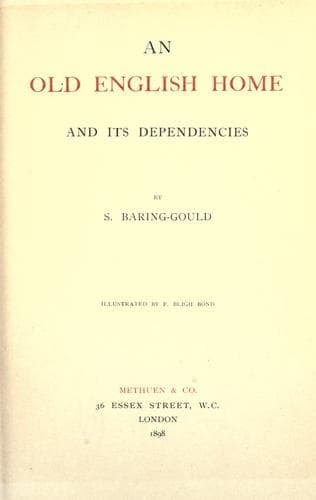
An Old English Home and Its DependenciesBaring-Gould, S. (Sabine)
History
An Old English Home and Its Dependencies
Baring-Gould, S. (Sabine)
England -- Social life and customs
There was every temptation to this young man to become a ne'er-do-weel,
but he did not give way to the temptation. He recognized the fact that
he had made a mistake, and he took the consequences like a man. But,
then, it is, perhaps, one only in five of those who make these mistakes
who has the courage to accept the results, and accommodate himself to
them.
Where there is a sound substratum of healthy conscience and force of
character, there one may always hope that a mistake in early life will
right itself.
But if there be mere love of lawlessness, mere wilfulness, in the
outbreaks of youth, then there is no redemption, the ne'er-do-weel boy
remains a ne'er-do-weel to the end of the chapter.
I remember one such. I knew him as a boy, and confess to have
entertained a liking for him; but his escapades passed all bounds of
moderation. A good-natured, chestnut-haired boy he was, with clear,
trembling blue eyes, a fair complexion somewhat marred by freckles,
and straight, elastic figure. Unhappily this lad had not parents who
taught their children what would do them good in life; nor kept them to
the National School, where they might have acquired that which their
parents neglected to inculcate.
The young fellow sometimes came to church, and then went into the
gallery behind the choir. Now, in the choir sat a young fellow with a
head covered with natural curls of a tow colour, on Sundays drenched
in hair-oil. One Sunday the scapegrace thrust a lighted match into the
mass of oiled curls, and the head blazed up at once.
The same ne'er-do-weel, whilst he was ringing the tenor bell, suddenly
threw the loop of the rope over the neck of the next man, who was
instantly whisked up against the belfry floor above and thrown down,
and very nearly killed.
On again another occasion, he thrashed a fellow called "Old Straw"
with a flail, saying that he was bent on finding if there was any good
to be got out of him. He broke Straw's leg, and was sentenced by the
magistrates to be put in the stocks.
That was the last occasion when stocks were used in England, and so
angry was the squire at the revival of the stocks, that after the
sentence had been carried out he had them chopped up and burnt.
The disgrace of the stocks was too much for our ne'er-do-weel; he
left the parish and entered the army, but had to leave--he was a
ne'er-do-weel under the colours as in fustian. Since then he has been
about the world--a ne'er-do-weel everywhere.
The other day the church bell was tolling. It was for this
ne'er-do-weel. He had returned home to die. The sole wish in the heart
of the man with a wasted life was to lie, to cast down the wreck of his
body, in the earth of the native parish which had bred him, and to have
no headstone to mark the mound under which lay naught but the ashes of
a ne'er-do-weel.
[Illustration]
[Illustration: HEDGES]
CHAPTER XIII.
Public-domain text, read in full here on John Shaqi.
Reviews
Reviews
No reviews yet
Be the first to share your thoughts on this work.
Elsewhere in the archive
Join the Discussion
Join the discussion
Sign in to leave a comment or review.
Sign InorCreate an account