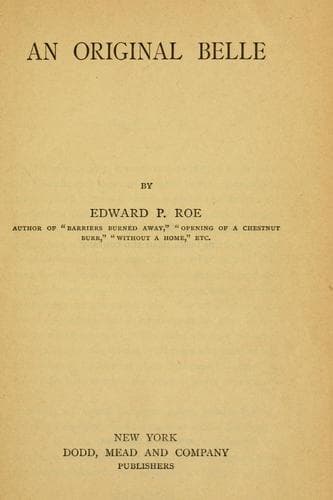
Love stories; United States -- History -- Civil War, 1861-1865 -- Fiction
A RUDE AWAKENING.
MARIAN VOSBURGH had been content with her recognized position
as a leading belle. An evening spent in her drawing-room revealed
that; but at the close of the particular evening which it was our
privilege to select there occurred a trivial incident. She was led
to think, and thought is the precursor of action and change in all
natures too strong and positive to drift. On that night she was
an ordinary belle, smiling, radiant, and happy in following the
traditions of her past.
She had been admired as a child, as a school-girl, and given a
place among the stars of the first magnitude since her formal debut.
Admiration was as essential as sunshine; or, to change the figure,
she had a large and a natural and healthful appetite for it. She was
also quite as much entitled to it as the majority of her class.
Thus far she had accepted life as she found it, and was in the
main conventional. She was not a deliberate coquette; it was not
her recognized purpose to give a heartache to as many as possible;
she merely enjoyed in thoughtless exultation her power to attract
young men to her side. There was keen excitement in watching them,
from the moment of introduction, as they passed through the phases
of formal acquaintanceship into relations that bordered on sentiment.
When this point was reached experiences sometimes followed which
caused not a little compunction.
She soon learned that society was full of men much like herself in
some respects, ready to meet new faces, to use their old compliments
and flirtation methods over and over again. They could look unutterable
things at half a dozen different girls in the same season, while
their hearts remained as invulnerable as old-fashioned pin-cushions,
heart-shaped, that adorn country "spare rooms." But now and then
a man endowed with a deep, strong nature would finally leave her
side in troubled wonder or bitter cynicism. Her fair, young face,
her violet eyes, so dark as to appear almost black at night, had
given no token that she could amuse herself with feelings that
touched the sources of life and death in such admirers.
"They should have known better, that I was not in earnest," she
would say, petulantly, and more or less remorsefully.
But these sincere men, who had been so blind as to credit her with
gentle truth and natural intuition, had some ideal of womanhood
which had led to their blunder. Conscious of revealing so much
themselves by look, tone, and touch of hand, eager to supplement
one significant glance by life-long loyalty, they were slow in
understanding that answering significant glances meant only, "I
like you very well,--better than others, just at present; but then
I may meet some one to-morrow who is a great deal more fun than
you are."
Public-domain text, read in full here on John Shaqi.
Reviews
Reviews
No reviews yet
Be the first to share your thoughts on this work.
Join the Discussion
Join the discussion
Sign in to leave a comment or review.
Sign InorCreate an account