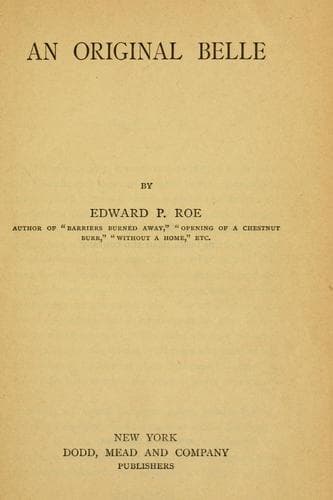
Love stories; United States -- History -- Civil War, 1861-1865 -- Fiction
He drew himself up, saluted her a la militaire, right-about-faced
with the stiffness of a ramrod, and was departing, when a light
hand touched his arm, and Marian said, with a look so kind and
sympathetic that his eyes fell before it: "Report to me occasionally,
Captain Strahan. There are my colors;" and she gave him a white
rose from her belt.
His mouth quivered slightly, but with a rather faltering laugh
he replied, as he put the rose to his lips, "Never let the color
suggest that I will show the white feather;" and then he began his
military career with a precipitate retreat.
CHAPTER VIII.
CHARMED BY A CRITIC.
"WHAT next?" was Marian's wondering query after Mr. Strahan's
departure. The change of motive which already had had no slight
influence on her own action and feeling had apparently ushered in
a new era in her experience; but the sense of novelty in personal
affairs was quite lost as she contemplated the transformation in
the mercurial Strahan, who had apparently been an irredeemable fop.
That the fastidious exquisite should tramp through Virginia mud,
and face a battery of hostile cannon, appeared to her the most
marvellous of human paradoxes. An hour before she would have declared
the idea preposterous. Now she was certain he would do all that he
had said, and would do it in the manner satirical and deprecatory
towards himself which she had suggested.
Radical as the change seemed, she saw that it was a natural one
as he had explained it. If there was any manhood in him the times
would evoke it. After all, his chief faults had been youth and
a nature keenly sensitive to certain social influences. Belonging
to a wealthy and fashionable clique in the city, he had early been
impressed by the estimated importance of dress and gossip. To excel
in these, therefore, was to become pre-eminent. As time passed,
however, the truth, never learned by some, that his clique was not
the world, began to dawn on him. He was foolish, but not a fool;
and when he saw young fellows no older than himself going to the
front, when he read of their achievements and sufferings, he drew
comparisons. The result was that he became more and more dissatisfied.
He felt that he was anomalous, in respect not only to the rural
scenery of his summer home, but to the times, and the conviction
was growing that the only way to right himself was to follow the
host of American youth who had gone southward. It was a conviction to
which he could not readily yield, and which he sought to disguise
by exaggerating his well-known characteristics. People of his
temperament often shrink from revealing their deeper feelings,
believing that these would seem to others so incongruous as to call
forth incredulous smiles. Strahan was not a coward, except in the
presence of ridicule. This had more terrors for him than all the
guns of the Confederacy; and he knew that every one, from his own
family down, would laugh at the thought of his going to the war.
Public-domain text, read in full here on John Shaqi.
Reviews
Reviews
No reviews yet
Be the first to share your thoughts on this work.
Join the Discussion
Join the discussion
Sign in to leave a comment or review.
Sign InorCreate an account