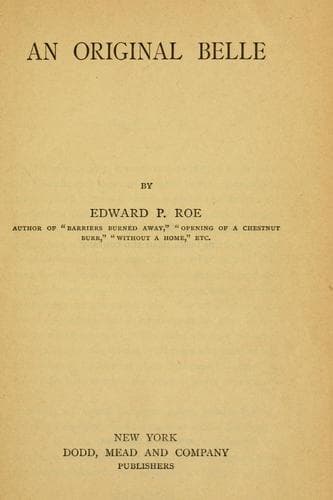
Love stories; United States -- History -- Civil War, 1861-1865 -- Fiction
At last the dainty apartment, the merry campaigning-ground, was
darkened, and Marian, flushed, wearied, and complacent, stepped
out on the piazza to breathe for a few moments the cool, fragrant
air. She had dropped into a rustic seat, and was thinking over
the events of the evening with an amused smile, when the following
startling words arose from the adjacent shrubbery:--
"Arrah, noo, will ye niver be sinsible? Here I'm offerin' ye me
heart, me loife. I'd be glad to wourk for ye, and kape ye loike a
leddy. I'd be thrue to ye ivery day o' me loife,--an' ye knows it,
but ye jist goes on makin' eyes at this wan an' flirtin' wid that
wan an' spakin' swate to the t'other, an' kapin' all on the string
till they can nayther ate nor slape nor be half the min they were
till ye bewildered 'em. Ye're nothin' but a giddy, light-minded,
shallow crather, a spoilin' min for your own fun. I've kep' company
wid ye a year, and ye've jist blowed hot and cowld till I'm not
meself any more, and have come nigh losin' me place. Noo, by St.
Patrick, ye must show whether ye're a woman or a heartless jade
that will sind a man to the divil for sport."
These words were poured out with the impetuosity of longsuffering
endurance finally vanquished, and before the speaker had concluded
Marian was on her way to the door, that she might not listen to a
conversation of so delicate a nature. But she did not pass beyond
hearing before part of the reply reached her.
"Faix, an' I'm no wourse than me young mistress."
It was a chance arrow, but it went straight to the mark, aad when
Marian reached her room her cheeks were aflame.
CHAPTER II.
A NEW ACQUAINTANCE.
Gross matter can change form and character in a moment, when merely
touched by the effective agent. It is easy to imagine, therefore,
how readily a woman's quick mind might be influenced by a truth
or a thought of practical and direct application. All the homilies
ever written, all the counsel of matrons and sages, could not
have produced on Marian so deep an impression as was made by these
few chance words. They came as a commentary, not only on her past
life, but on the past few hours. Was it true, then, that she was no
better than the coquettish maid, the Irish servant in the family's
employ? Was she, with her education and accomplishments, her social
position and natural gifts, acting on no higher plane, influenced
by no worthier motives and no loftier ambition? Was the ignorant
girl justified in quoting her example in extenuation of a course
that to a plain and equally ignorant man seemed unwomanly to the
last degree?
Wherein was she better? Wherein lay the difference between her and
the maid?
Public-domain text, read in full here on John Shaqi.
Reviews
Reviews
No reviews yet
Be the first to share your thoughts on this work.
Join the Discussion
Join the discussion
Sign in to leave a comment or review.
Sign InorCreate an account