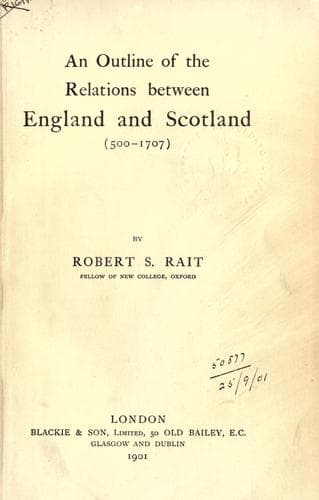
An Outline of the Relations between England and Scotland (500-1707)Rait, Robert S. (Robert Sangster)
History
An Outline of the Relations between England and Scotland (500-1707)
Rait, Robert S. (Robert Sangster)
England -- Foreign relations -- Scotland; Scotland -- Foreign relations -- England
In 1635, canons were issued for the Church of Scotland, which owed their
existence to the dangerous meddling of Laud, now Archbishop of
Canterbury. James, who loved Episcopacy, had dreaded the influence of
Laud in Scotland; his fear was justified, for it was given to Laud to
make an Episcopal Church impossible north of the Tweed. Although certain
of the Scottish bishops had expressed approval of these canons, they
were enjoined in the Church by royal authority, and the Scots, whose
theory of the rights of the Church was much more "high" than that of
Laud, would, on this account alone, have met them with resistance. But
the canons used words and phrases which were intolerable to Scottish
ears. They spoke of a "chancel" and they commended auricular confession;
they gave the Scottish bishops something like the authority of their
English brethren, to the detriment of minister and kirk-session, and
they made the use of a new prayer-book compulsory, and forbade any
objection to it. Two years elapsed before the book was actually
introduced. It was English, and it had been forced upon the Church by
the State, and, worse than this, it was associated with the hated name
of Laud and with his suspected designs upon the Protestant religion.
When it came it was found to follow the English prayer-book almost
exactly; but such changes as there were seemed suspicious in the
extreme. In the communion service the rubric preceding the prayer of
consecration read thus: "During the time of consecration he shall stand
at such a part of the holy table where he may with the more ease and
decency use both his hands". The reference to both hands was suspected
to mean the Elevation of the Host, and this suspicion was confirmed by
the omission of the sentences "Take and eat this in remembrance that
Christ died for thee, and feed on him in thy heart by faith, with
thanksgiving", and "Drink this in remembrance that Christ's blood was
shed for thee, and be thankful", from the words of administration. On
more general grounds, too, strong objection was taken to the book, and
on July 23rd, 1637, there occurred the famous riot in St. Giles's, which
has become connected with the name of Jennie Geddes. The objection was
not, in any sense, to read prayers in themselves; the Book of Common
Order had been read in St. Giles's that very morning. The difficulty lay
in the particular book, and it is notable that the cries which have come
down to us as prefacing the riot are all indicative of a suspected
attempt to reintroduce Roman Catholicism. "The mass is entered upon us."
"Baal is in the Church." "Darest thou sing mass in my lug."
Public-domain text, read in full here on John Shaqi.
Reviews
Reviews
No reviews yet
Be the first to share your thoughts on this work.
Elsewhere in the archive
Join the Discussion
Join the discussion
Sign in to leave a comment or review.
Sign InorCreate an account