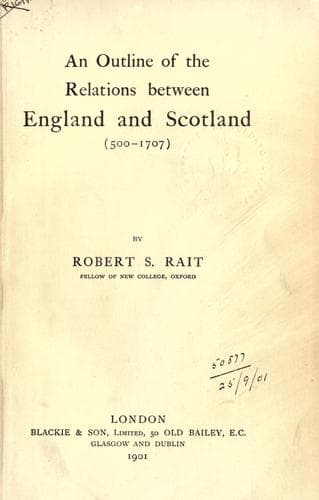
An Outline of the Relations between England and Scotland (500-1707)Rait, Robert S. (Robert Sangster)
History
An Outline of the Relations between England and Scotland (500-1707)
Rait, Robert S. (Robert Sangster)
England -- Foreign relations -- Scotland; Scotland -- Foreign relations -- England
The Privy Council was negligent in punishing the rioters, and it soon
became evident that they had public opinion behind them. Alexander
Henderson, who ministered to a Fifeshire congregation in the old Norman
church of Leuchars, and whom the king was to meet in other
circumstances, issued a respectful and moderate protest, in which he did
not deal with the particular points at issue, but asserted the
ecclesiastical independence of Scotland. Riots continued to disturb
Edinburgh, and Charles was impotent to suppress them. He refused
Henderson's "Supplication"; its supporters drew up a second petition
boldly asking that the bishops should be tried as the real authors of
the disturbances, and, in November, 1637, they chose a body of
commissioners to represent them. These commissioners, and some
sub-committees of them, are known in Scottish history as The Tables, the
name being applied to several different bodies. Charles replied to the
second petition in wrathful terms, and it was decided to revive the
National Covenant of 1581, to renounce popery. It had been drawn up
under fear of a popish plot, and was itself an expansion of the Covenant
of 1557. To it was now added a declaration suited to immediate
necessities. On the 1st and 2nd March, 1638, it was signed by vast
multitudes in the churchyard of Greyfriars, in Edinburgh, and it
continued to be signed, sometimes under pressure, throughout the land.
Hamilton, Charles's agent in Scotland, was quite unable to meet the
situation. In the end Charles had to agree to the meeting of a General
Assembly in Glasgow, in November, 1638. Hamilton, the High Commissioner,
attempted to obtain the ejection of laymen and to create a division
among his opponents. When he failed in this, he dissolved the Assembly
in the king's name. At the instance of Henderson, supported by Argyll,
the Assembly refused to acknowledge itself dissolved, and proceeded to
abolish Episcopacy and re-establish the Presbyterian form of Church
government.
Public-domain text, read in full here on John Shaqi.
Reviews
Reviews
No reviews yet
Be the first to share your thoughts on this work.
Elsewhere in the archive
Join the Discussion
Join the discussion
Sign in to leave a comment or review.
Sign InorCreate an account