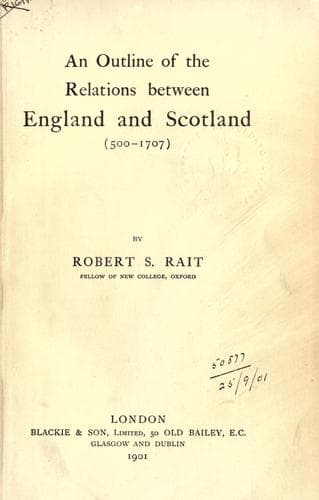
An Outline of the Relations between England and Scotland (500-1707)Rait, Robert S. (Robert Sangster)
History
An Outline of the Relations between England and Scotland (500-1707)
Rait, Robert S. (Robert Sangster)
England -- Foreign relations -- Scotland; Scotland -- Foreign relations -- England
The king, on his part, began to concert measures with his Privy Council
for the subjugation of Scotland. The "Committee on Scotch affairs" of
the English Privy Council was obviously unconstitutional, but matters
were fast drifting towards civil war, and it was no time to consider
constitutional niceties. It is much more important that the committee
was divided and useless. Wentworth, writing from Ireland, advised the
king to maintain a firm attitude, but not to provoke an outbreak of war
at so inconvenient a moment. Charles again attempted a compromise. He
offered to withdraw Laud's unlucky service-book, the new canons, and
even the Articles of Perth, and to limit the power of the bishops; and
he asked the people to sign the Covenant of 1580-81, on which the new
Covenant was based, but which, of course, contained no reference to
immediate difficulties. But it was too late; the sentiment of religious
independence had become united to the old feeling of national
independence, and war was inevitable. The Scots were fortunate in their
leaders. In the end of 1638 there returned to Scotland from Germany,
Alexander Leslie, the great soldier who had fought for Protestantism
under Gustavus Adolphus. In February, 1639, he took command of the army
of the Covenant, which had been largely reinforced by veterans from the
Thirty Years' War. A more attractive personality than Leslie's was that
of the young Earl of Montrose, who had attached himself with enthusiasm
to the national cause, and had attempted to convert the people of
Aberdeen to covenanting principles. Charles, on his part, asserted that
his throne was in danger, and that the Scottish preparations constituted
a menace to the kingdom of England, and so attempted to rouse enthusiasm
for himself.
Public-domain text, read in full here on John Shaqi.
Reviews
Reviews
No reviews yet
Be the first to share your thoughts on this work.
Elsewhere in the archive
Join the Discussion
Join the discussion
Sign in to leave a comment or review.
Sign InorCreate an account