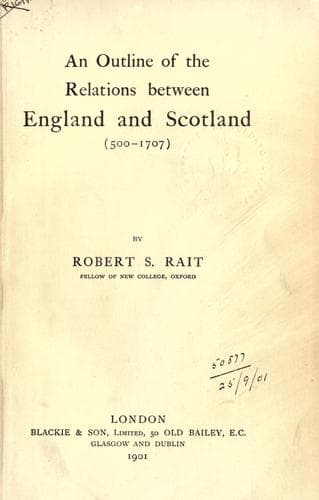
An Outline of the Relations between England and Scotland (500-1707)Rait, Robert S. (Robert Sangster)
History
An Outline of the Relations between England and Scotland (500-1707)
Rait, Robert S. (Robert Sangster)
England -- Foreign relations -- Scotland; Scotland -- Foreign relations -- England
It was clear that the pacification was only a truce, for no exact terms
had been agreed upon, and both sides thoroughly distrusted each other.
Disputes immediately arose about the constitution of Parliament and the
Assembly. Charles refused to rescind the acts constituting Episcopacy
legal, and it is clear that he never intended to keep his promise to the
Scots, who, on their part, were too suspicious of his good faith to
carry out their part of the agreement. In the end Assembly and
Parliament alike abolished Episcopacy, and Parliament passed several
acts to ensure its own supremacy. Charles refused to assent to these
Acts, and prorogued Parliament from November, 1639, to June, 1640. The
result of the king's evident disinclination to implement the Treaty of
Berwick, was an interesting attempt to undo the work of the preceding
century by a reversion to the old policy of a French alliance. It was,
of course, impossible thus to turn back, and Richelieu met the Scottish
offers with a decisive rebuff, while the fact of these treasonable
negotiations became known to Charles, and embittered the already bitter
controversy. A new attempt at negotiation failed, and in June, 1640, the
second Bishops' War began. As usual the north suffered, especially from
the fierceness of the Earl of Argyll, who disliked the more moderate
policy advocated by Montrose. The king's English difficulties were
increasing, and the Scots had now many sympathizers among Englishmen,
who looked upon them as fighting for the same cause of Protestantism and
constitutional government.
Public-domain text, read in full here on John Shaqi.
Reviews
Reviews
No reviews yet
Be the first to share your thoughts on this work.
Elsewhere in the archive
Join the Discussion
Join the discussion
Sign in to leave a comment or review.
Sign InorCreate an account