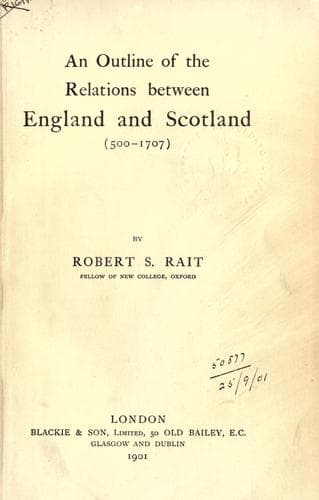
An Outline of the Relations between England and Scotland (500-1707)Rait, Robert S. (Robert Sangster)
History
An Outline of the Relations between England and Scotland (500-1707)
Rait, Robert S. (Robert Sangster)
England -- Foreign relations -- Scotland; Scotland -- Foreign relations -- England
In August the Scots invaded England for the first time since the
minority of Mary Stuart, and, on August 28th, they defeated a portion of
the king's army at Newburn, a ford near Newcastle. The town was
immediately occupied, and from Newcastle the invaders advanced to the
Tees and seized Durham. Charles was forced, a second time, to give way.
In October he agreed that the Scottish army of occupation should be paid
until the English Parliament, which he was about to summon, might make a
final arrangement. By Parliament alone could the Scots be paid, and
thus, by a strange irony of fate, the occupation of the northern
counties by a Scottish army was, for the time, the best guarantee of
English liberties. There were, however, points on which the Scottish
army and the English Parliament found it difficult to agree, and it was
not till August, 1641, that the Scots recrossed the Tweed. Charles, who
hoped to enlist the sympathy of the Scots in his struggle with the
English Parliament, paid a second visit to Edinburgh, where he gave his
assent to the abolition of Episcopacy, and to the repeal of the Acts
which had given rise to the dispute. But it became evident that the
Parliament, and not the king, was to bear rule in Scotland. The king's
stay in Edinburgh was marked by what is known as "The Incident", a
mysterious plot to capture Argyll and Hamilton, who was now the ally of
Argyll. It was supposed that the king was cognizant of the plan; he had
to defend himself from the accusation, and was declared guiltless in the
matter. At the time of the Incident, Argyll fled, but soon returned, and
Charles had to yield to him in all things. Parliament, under Argyll,
appointed all officials. Argyll himself was made a marquis, and Leslie
became Earl of Leven. There was a general amnesty, and among those who
obtained their liberty was the Earl of Montrose, who had been imprisoned
in May for making terms with the king. In November, 1641, Charles left
Scotland for London, to face the English Parliament. He can scarcely
have hoped for Scottish aid, and when, a few months later, he was on the
verge of hostilities and made a request for assistance, it was twice
refused.
Public-domain text, read in full here on John Shaqi.
Reviews
Reviews
No reviews yet
Be the first to share your thoughts on this work.
Elsewhere in the archive
Join the Discussion
Join the discussion
Sign in to leave a comment or review.
Sign InorCreate an account