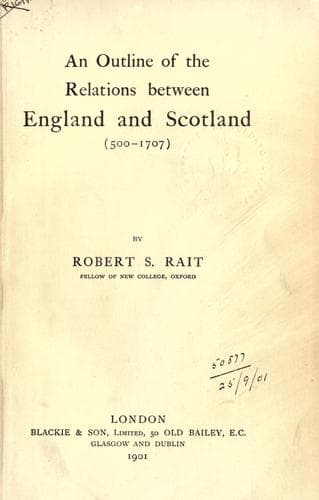
An Outline of the Relations between England and Scotland (500-1707)Rait, Robert S. (Robert Sangster)
History
An Outline of the Relations between England and Scotland (500-1707)
Rait, Robert S. (Robert Sangster)
England -- Foreign relations -- Scotland; Scotland -- Foreign relations -- England
The news of the execution of the king was at once followed by the fall
of Argyll and his party. The Scots had no sympathy with English
republicanism, and they were alarmed by the growth of Independency in
England. On February 5th Charles II was proclaimed King of Great
Britain, France, and Ireland, and the Scots declared themselves ready to
defend his cause by blood, if only he would take the Covenant. This the
young king refused to do while he had hopes of success in Ireland.
Meanwhile three of his most loyal friends perished on the scaffold. The
English, who held the Duke of Hamilton as a prisoner, put him to death
on March 9th, 1649, and on the 22nd day of the same month the Marquis of
Huntly was beheaded at Edinburgh. On April 27th, Montrose, who had
collected a small army and taken the field in the northern Highlands,
was defeated at Carbisdale and taken prisoner. On the 25th May he was
hanged in Edinburgh, and with his death the story is deprived of its
hero.
The pressure of misfortune finally drove Charles to accept the Scottish
offers. Even while Montrose was fighting his last battle, his young
master was negotiating with the Covenanters. Conferences were held at
Breda in the spring of 1650, and Charles landed at the mouth of the
river Spey on the 3rd July, having taken the Covenant. In the middle of
the same month Cromwell crossed the Tweed at the head of an English
army. The Scots, under Leven and David Leslie, took up a position near
Edinburgh, and, after a month's fruitless skirmishing, Cromwell had to
retire to Dunbar, whither Leslie followed him. By a clever manoeuvre,
Leslie intercepted Cromwell's retreat on Berwick, while he also seized
Doon Hill, an eminence commanding Dunbar. The Parliamentary Committee,
under whose authority Leslie was acting, forced him to make an attack to
prevent Cromwell's force from escaping by sea. The details of the battle
have been disputed, and the most convincing account is that given by Mr.
Firth in his "Cromwell". When Leslie left the Doon Hill his left became
shut in between the hill and "the steep ravine of the Brock burn", while
his centre had not sufficient room to move. Cromwell, therefore, after a
feint on the left, concentrated his forces against Leslie's right, and
shattered it. The rout was complete, and Leslie had to retreat to
Stirling, while the Lowlands fell into Cromwell's hands. Cromwell was
conciliatory, and a considerable proportion of Presbyterians took up an
attitude hostile to the king's claims. The supporters of Charles were
known as Resolutioners, or Engagers, and his opponents as Protesters or
Remonstrants. The consequence was that the old Royalists and
Episcopalians began to rejoin Charles. Before the battle of Dunbar
(September 2nd) Charles had been really a prisoner in the hands of the
Covenanters, who had ruled him with a rod of iron. As the stricter
Presbyterians withdrew, and their places were filled by the "Malignants"
Public-domain text, read in full here on John Shaqi.
Reviews
Reviews
No reviews yet
Be the first to share your thoughts on this work.
Elsewhere in the archive
Join the Discussion
Join the discussion
Sign in to leave a comment or review.
Sign InorCreate an account