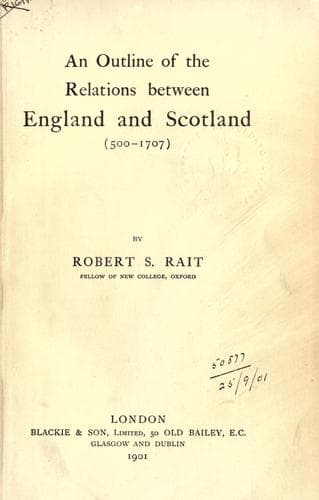
An Outline of the Relations between England and Scotland (500-1707)Rait, Robert S. (Robert Sangster)
History
An Outline of the Relations between England and Scotland (500-1707)
Rait, Robert S. (Robert Sangster)
England -- Foreign relations -- Scotland; Scotland -- Foreign relations -- England
When Charles surrendered himself to the Scots, in May, 1646, his friends
in Scotland were helpless, and he had to meet the Presbyterian leaders
without any hope beyond that of being able to take advantage of the
differences of opinion between Presbyterians and Independents, which
were fast assuming critical importance. The king held at Newcastle a
conference with Alexander Henderson, which led to no definite result. In
the end the Scots offered to adopt the king's cause if he would accept
Presbyterianism. This he declined to do, and his refusal left the Scots
no choice except keeping him a prisoner or surrendering him to his
English subjects. They owed him no gratitude, and, while it might be
chivalrous, it could scarcely be expedient to retain his person. While
he was unwilling to accede to their conditions they were powerless to
give him any help. He was therefore handed over to the commissioners of
the English Parliament, and the Scots, on the 30th January, 1647,
returned home, having been paid, as the price of the king's surrender,
the money promised them by the English Parliament when they entered into
the struggle in 1644.
In the end of 1647 the Scots again entered into the long series of
negotiations with the king. When Charles was a prisoner at Newport, and
while he was arranging terms with the English, he entered into a secret
agreement with commissioners from Scotland. The "Engagement", as it was
called, embodied the conditions which Charles had refused at
Newcastle--the recognition of Presbytery in Scotland and its
establishment in England for three years, the king being allowed
toleration for his own form of worship. The Engagement was by no means
unanimously carried in the Scottish Parliament, and its results were
disastrous to Charles himself. It caused the English Parliament to pass
the vote of No Addresses, and the second civil war, which it helped to
provoke, had a share in bringing about his death. The Duke of Hamilton
led a small army into England, where in August 17th, 1648, it was
totally defeated by Cromwell at Preston. Meanwhile the Hamilton party
had lost power in Scotland, and when Cromwell entered Scotland, Argyll,
who had opposed the Engagement, willingly agreed to his conditions, and
accepted the aid of three English regiments. In the events of the next
six months Scotland had no part nor lot. The responsibility for the
king's death rests on the English Government alone.
Public-domain text, read in full here on John Shaqi.
Reviews
Reviews
No reviews yet
Be the first to share your thoughts on this work.
Elsewhere in the archive
Join the Discussion
Join the discussion
Sign in to leave a comment or review.
Sign InorCreate an account