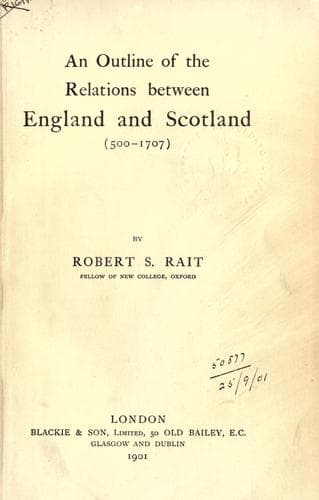
An Outline of the Relations between England and Scotland (500-1707)Rait, Robert S. (Robert Sangster)
History
An Outline of the Relations between England and Scotland (500-1707)
Rait, Robert S. (Robert Sangster)
England -- Foreign relations -- Scotland; Scotland -- Foreign relations -- England
A small rising at
Aird's Moss in Ayrshire, in 1680, was easily suppressed. In 1681 the
Scottish Parliament prescribed as a test the disavowal of the National
Covenant of 1638 and the Solemn League and Covenant of 1644, and it
declared that any attempt to alter the succession involved the subjects
"in perjury and rebellion". In connection with the Test Act, an
opportunity was found for convicting the Earl of Argyll[91] of treason.
His property was confiscated, but he himself was allowed to escape. The
last years of the reign, under the administration of the Duke of York,
were marked by exceptional cruelty in connection with the religious
persecutions. The expeditions of Claverhouse, the case of the Wigtown
martyrs, and the horrible cruelties of the torture-room have given to
these years the title of "the Killing time".
The Scottish Parliament welcomed King James VII with fulsome adulation.
But the new king was scarcely seated on the throne before a rebellion
broke out. The Earl of Argyll adopted the cause of Monmouth, landed in
his own country, and marched into Lanarkshire. His attempt was an entire
failure: nobody joined his standard, and he himself, failing to make
good his retreat, was captured and executed without a new trial. The
Parliament again enforced the Test Act, and renewed the Conventicle Act,
making it a capital offence even to be present at a conventicle. The
persecutions continued with renewed vigour. James failed in persuading
even the obsequious Parliament to give protection to the Roman
Catholics. He attempted to obtain the same end by a Declaration of
Indulgence, of which the Covenanters might be unable to avail
themselves, but in its final form, issued in May, 1688, it included
them. The conjunction of popery and absolute prerogative thoroughly
alarmed the Scots, and the news of the English Revolution was received
with general satisfaction. The effect of the long struggle had been to
weaken the country in many ways. Thousands of her bravest sons had died
on the scaffold or on the battle-field or in the dungeons of Dunnottar,
or had been exiled to the plantations. Trade and commerce had declined.
The records of the burghs show us how harbours were empty and houses
ruinous, where, a century earlier, there had been a thriving trade.
Scotland in 1688 was in every way, unless in moral discipline, poorer
than she had been while England was still the "auld enemy".
FOOTNOTES:
[Footnote 89: Sabbath observance had been introduced from England six
centuries earlier. Cf. p. 14.]
[Footnote 90: Justices of the peace were appointed throughout the
country, and heritable jurisdictions were abolished.]
[Footnote 91: The son of the Marquis who was executed in 1661. The
earldom, but not the marquisate, had been restored in 1663.]
CHAPTER XI
THE UNION OF THE PARLIAMENTS
1689-1707
Public-domain text, read in full here on John Shaqi.
Reviews
Reviews
No reviews yet
Be the first to share your thoughts on this work.
Elsewhere in the archive
Join the Discussion
Join the discussion
Sign in to leave a comment or review.
Sign InorCreate an account