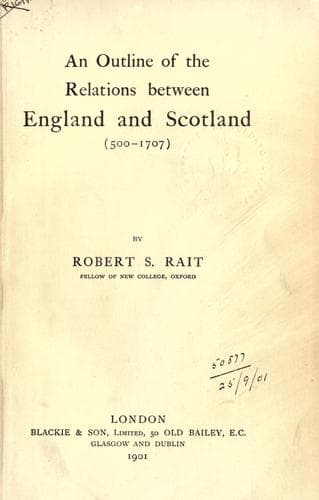
An Outline of the Relations between England and Scotland (500-1707)Rait, Robert S. (Robert Sangster)
History
An Outline of the Relations between England and Scotland (500-1707)
Rait, Robert S. (Robert Sangster)
England -- Foreign relations -- Scotland; Scotland -- Foreign relations -- England
On April 4th, 1689, a Convention of the Estates of Scotland met to
consider the new situation which had been created by the course of
events in England. They had no difficulty in determining their course of
action, nor any scruples about deposing James, who was declared to have
forfeited his right to the crown. A list was drawn up of the king's
misdeeds. They included "erecting schools and societies of Jesuits,
making papists officers of state", taxation and the maintenance of a
standing army without consent of Parliament, illegal imprisonments,
fines, and forfeitures, and interference with the charters of burghs.
The crown was then offered to William and Mary, but upon certain
strictly defined conditions. All the acts of the late king which were
included in the list of his offences must be recognized as illegal: no
Roman Catholic might be King or Queen of Scotland; and the new
sovereigns must agree to the re-establishment of Presbytery as the
national religion. It was obvious that the nation was not unanimous.
"To the Lords of Convention, 'twas Claverhouse spoke,
Ere the King's crown go down there are crowns to be broke."
The opponents of the revolution settlement consisted mainly of the old
Royalist and Episcopalian party, the representatives of those who had
followed Montrose to victory, and the supporters of the Restoration
Government. As the Great Rebellion had made Royalists of the Scottish
Episcopalians, so the Revolution could not but convert them into
Jacobites. Their leader was James Graham of Claverhouse, who retreated
from Edinburgh to the north to prepare for a campaign against the new
government. The discontent was not confined to the Episcopalian party.
Such Roman Catholics as there were in Scotland at the time were prepared
to take up arms for a Stuart king who was a devout adherent of their
religion. Moreover, the Presbyterians themselves were not united. A
party which was to grow in strength, and which now included a
considerable number of extreme Presbyterians, still longed, in spite of
their experience of Charles II, for a covenanted king, and looked with
great distrust upon William and Mary. The triumphant party of moderate
Presbyterians, who probably represented most faithfully the feeling of
the nation, acted throughout with considerable wisdom. The acceptance of
the crown converted the Convention into a Parliament, and the Estates
set themselves to obtain, in the first place, their own freedom from the
tyranny of the committee known as the "Lords of the Articles", through
which James VI and his successors had kept the Parliament in
subjection. William was unwilling to lose entirely this method of
controlling his new subjects, but he had to give way. The Parliament
rescinded the Act of Charles II asserting his majesty's supremacy "over
all persons and in all causes ecclesiastical" as "inconsistent with the
establishment of Church government now desired", but, in the military
Public-domain text, read in full here on John Shaqi.
Reviews
Reviews
No reviews yet
Be the first to share your thoughts on this work.
Elsewhere in the archive
Join the Discussion
Join the discussion
Sign in to leave a comment or review.
Sign InorCreate an account