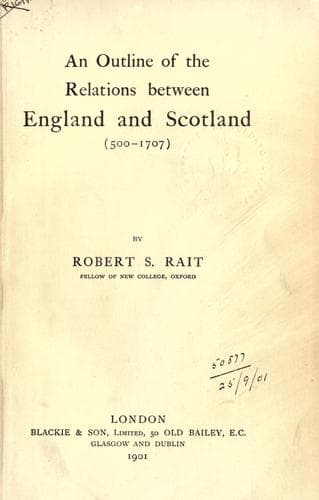
An Outline of the Relations between England and Scotland (500-1707)Rait, Robert S. (Robert Sangster)
History
An Outline of the Relations between England and Scotland (500-1707)
Rait, Robert S. (Robert Sangster)
England -- Foreign relations -- Scotland; Scotland -- Foreign relations -- England
It was not an easy task, even in England, for there could be no union
without complete freedom of trade, and many Englishmen were most
unwilling to yield on this point. In Scotland the difficulties to be
overcome were much greater. The whole nation, irrespective of politics
and religion, felt bitterly the indignity of surrendering the
independent existence for which Scotland had fought for four hundred
years. It could not but be difficult to reconcile an ancient and
high-spirited people to incorporation with a larger and more powerful
neighbour, and the whole population mourned the approaching loss of
their Parliament and their autonomy. Almost every section had special
reasons for opposing the measure. For the Jacobites an Act of Union
meant that Scotland was irretrievably committed to the Hanoverian
succession, and whatever force the Jacobites might be able to raise
after the queen's death must take action in the shape of a rebellion
against the _de facto_ government. It deprived them of all hope of
seizing the reins of power, and of using the machinery of government in
Scotland for the good of their cause--a _coup d'etat_ of which the Act
of Security gave considerable chance. On this very account the
triumphant Presbyterians were anxious to carry the union scheme, and the
correspondence of the Electress Sophia proves that the negotiations for
union were looked upon at Hanover as solely an important factor in the
succession controversy. But the recently re-established Presbyterian
Church of Scotland regarded with great anxiety a union with an
Episcopalian country, and hesitated to place their dearly won freedom at
the mercy of a Parliament the large majority of whom were Episcopalians.
The more extreme Presbyterians, and especially the Cameronians of the
west, were bitterly opposed to the project. They protested against
becoming subject to a Parliament in whose deliberations the English
bishops had an important voice, and against accepting a king who had
been educated as a Lutheran, and they clamoured for covenanted
uniformity and a covenanted monarch. By a curious irony of fate, the
Scottish Episcopalians were forced by their Jacobite leanings to act
with the extreme Presbyterians, and to oppose the scheme of amalgamation
with an Episcopalian country. The legal interest was strongly against a
proposal that might reduce the importance of Scots law and of Scottish
lawyers, while the populace of Edinburgh were furious at the suggestion
of a union, whose result must be to remove at once one of the glories of
their city and a valuable source of income. There was still another body
of opponents. The reign of William had been remarkable for the rise of
political parties. The two main factions were known as Williamites and
Cavaliers, and in addition to these there had grown up a Patriot or
Country party. It was brought into existence by the enthusiasm of
Fletcher of Saltoun, and it was based upon an antiquarian revival which
Public-domain text, read in full here on John Shaqi.
Reviews
Reviews
No reviews yet
Be the first to share your thoughts on this work.
Elsewhere in the archive
Join the Discussion
Join the discussion
Sign in to leave a comment or review.
Sign InorCreate an account