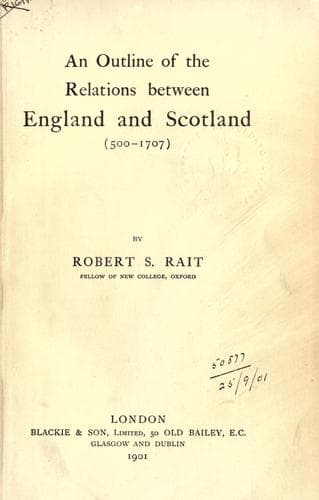
An Outline of the Relations between England and Scotland (500-1707)Rait, Robert S. (Robert Sangster)
History
An Outline of the Relations between England and Scotland (500-1707)
Rait, Robert S. (Robert Sangster)
England -- Foreign relations -- Scotland; Scotland -- Foreign relations -- England
In the reign of Charles II the Scots, who felt keenly the loss of the
freedom of trade which they had enjoyed under Cromwell, had themselves
broached the question of union, and William had brought it forward at
the beginning of his reign. It was, however, reserved for his successor
to see it carried. In March, 1702, the king died. The death of "William
II", as his title ran in the kingdom of Scotland, was received with a
feeling amounting almost to satisfaction. The first English Parliament
of Queen Anne agreed to the appointment of commissioners to discuss
terms of union, and the Estates of Scotland chose representatives to
meet them. But the English refused to give freedom of trade, and so the
negotiations broke down. In reply, the Scottish Parliament removed the
restrictions on the import of wines from France, with which country
England was now at war. In the summer of 1703 the Scots passed an Act of
Security, which invested the Parliament with the power of the crown in
case of the queen's dying without heirs, and entrusted to it the choice
of a Protestant sovereign "from the royal line". It refused to such king
or queen, if also sovereign of England, the power of declaring war or
making peace without the consent of Parliament, and it enacted that the
union of the crowns should determine after the queen's death unless
Scotland was admitted to equal trade and navigation privileges with
England. Further, the act provided for the compulsory training of every
Scotsman to bear arms, in order that the country might, if necessary,
defend its independence by the sword. The queen's consent to the Act of
Security was refused, and the bitterness of the national feeling was
accentuated by the suspicion of a Jacobite plot. Parliament had been
adjourned on 16th September, 1703. When it met in 1704 it again passed
the Act of Security, and an important section began to argue that the
royal assent was merely a usual form, and not an indispensable
authentication of an act. For some time, it seemed as if the two
countries were on the brink of war. But, as the union of the crowns had
been rendered possible by the self-restraint of a nation who could
accept their hereditary enemy as their hereditary sovereign, so now
Queen Anne's advisers resolved, with patient wisdom, to secure, at all
hazards, the union of the kingdoms.
Public-domain text, read in full here on John Shaqi.
Reviews
Reviews
No reviews yet
Be the first to share your thoughts on this work.
Elsewhere in the archive
Join the Discussion
Join the discussion
Sign in to leave a comment or review.
Sign InorCreate an account