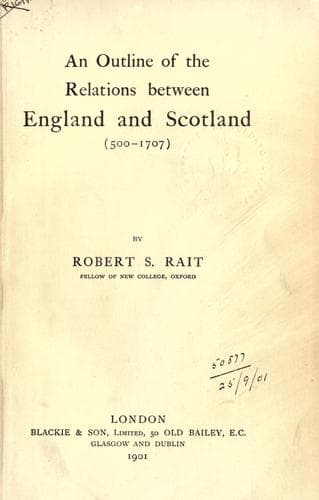
An Outline of the Relations between England and Scotland (500-1707)Rait, Robert S. (Robert Sangster)
History
An Outline of the Relations between England and Scotland (500-1707)
Rait, Robert S. (Robert Sangster)
England -- Foreign relations -- Scotland; Scotland -- Foreign relations -- England
We pass now to the third section of the supremacy argument. The district
to which we have referred as Lothian was, unquestionably, largely
inhabited by men of English race, and it formed part of the Northumbrian
kingdom. Within the first quarter of the eleventh century it had passed
under the dominion of the Celtic kings of Scotland. When and how this
happened is a mystery. The tract _De Northynbrorum Comitibus_ which used
to be attributed to Simeon of Durham, asserts that it was ceded by Edgar
to Kenneth and that Kenneth did homage, and this story, elaborated by
John of Wallingford, has been frequently given as the historical
explanation. But Simeon of Durham in his "History"[32] asserts that
Malcolm II, about 1016, wrested Lothian from the Earl of Northumbria,
and there is internal evidence that the story of Edgar and Kenneth has
been constructed out of the known facts of Malcolm's reign. It is, at
all events, certain that the Scottish kings in no sense governed Lothian
till after the battle of Carham in 1018, when Malcolm and the
Strathclyde monarch Owen, defeated the Earl of Northumbria and added
Lothian to his dominions. This conquest was confirmed by Canute in 1031,
and, in connection with the confirmation, the Chronicle again speaks of
a doubtful homage which the Scots king "not long held", and, again, the
Chronicle, or one version of it, adds an impossible statement--this time
about Macbeth, who had not yet appeared on the stage of history. The
year 1018 is also marked by the succession of Malcolm's grandson,
Duncan, to the throne of his kinsman, Owen of Strathclyde, and on
Malcolm's death in 1034 the whole of Scotland was nominally united under
Duncan I.[33] The consolidation of the kingdom was as yet in the future,
but from the end of the reign of Malcolm II there was but one Kingdom of
Scotland. From this united kingdom we must exclude the islands, which
were largely inhabited by Norsemen. Both the Hebrides and the islands of
Orkney and Shetland were outside the realm of Scotland.
The names of Macbeth and "the gentle Duncan" suggest the great drama
which the genius of Shakespeare constructed from the magic tale of
Hector Boece; but our path does not lie by the moor near Forres, nor
past Birnam Wood or Dunsinane. Nor does the historian of the relations
between England and Scotland have anything to tell about the English
expedition to restore Malcolm. All such tales emanate from Florence of
Worcester, and we know only that Siward of Northumbria made a fruitless
invasion of Scotland, and that Macbeth reigned for three years
afterwards.
Public-domain text, read in full here on John Shaqi.
Reviews
Reviews
No reviews yet
Be the first to share your thoughts on this work.
Join the Discussion
Join the discussion
Sign in to leave a comment or review.
Sign InorCreate an account