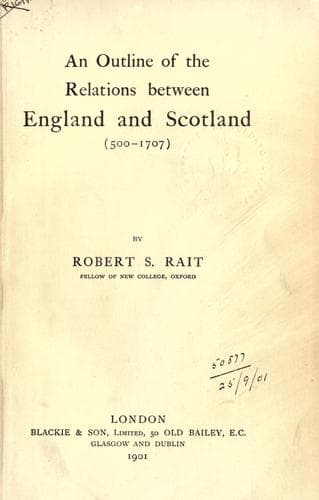
An Outline of the Relations between England and Scotland (500-1707)Rait, Robert S. (Robert Sangster)
History
An Outline of the Relations between England and Scotland (500-1707)
Rait, Robert S. (Robert Sangster)
England -- Foreign relations -- Scotland; Scotland -- Foreign relations -- England
It is not possible to credit David with any real affection for the
cause of the empress or with any higher motive than selfish greed, and
it can scarcely be claimed that he kept faith with Stephen. Such,
however, were the difficulties of the English king, that, in spite of
his crushing defeat, David reaped the advantages of victory. Peace was
made in April, 1139, by the Treaty of Durham, which secured to Prince
Henry the earldom of Northumberland, as an English fief. The Scottish
border line, which had successively enclosed Strathclyde and part of
Cumberland, and the Lothians, now extended to the Tees. David gave
Stephen some assistance in 1139, but on the victory of the Empress
Maud[37] at Lincoln, in 1141, David deserted the captive king, and was
present, on the empress's side, at her defeat at Winchester, in 1141.
Eight years later he entered into an agreement with the claimant, Henry
Fitz-Empress, afterwards Henry II, by which the eldest son of the
Scottish king was to retain his English fiefs, and David was to aid
Henry against Stephen. An unsuccessful attempt on England followed--the
last of David's numerous invasions. When he died, in 1153, he left
Scotland in a position of power with regard to England such as she was
never again to occupy. The religious devotion which secured for him a
popular canonization (he was never actually canonized) can scarcely
justify his conduct to Stephen. But it must be recollected that,
throughout his reign, there is comparatively little racial antagonism
between the two countries. David interfered in an English civil war, and
took part, now on one side, and now on the other. But the whole effect
of his life was to bring the nations more closely together through the
Norman influences which he encouraged in Scotland. His son and heir held
great fiefs in England,[38] and he granted tracts of land to
Anglo-Norman nobles. A Bruce and a Balliol, who each held possessions
both in Scotland and in England, tried to prevent the battle of the
Standard. Their well-meant efforts proved fruitless; but the fact is
notable and significant.
Public-domain text, read in full here on John Shaqi.
Reviews
Reviews
No reviews yet
Be the first to share your thoughts on this work.
Join the Discussion
Join the discussion
Sign in to leave a comment or review.
Sign InorCreate an account