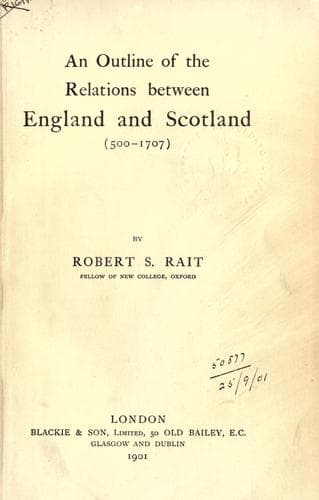
An Outline of the Relations between England and Scotland (500-1707)Rait, Robert S. (Robert Sangster)
History
An Outline of the Relations between England and Scotland (500-1707)
Rait, Robert S. (Robert Sangster)
England -- Foreign relations -- Scotland; Scotland -- Foreign relations -- England
decided, by the advice of the Great Council, to disown his allegiance to
the King of England, and to enter upon an alliance with France. It is
noteworthy that the policy of the French alliance, as an anti-English
movement, which became the watchword of the patriotic party in Scotland,
was inaugurated by John Balliol. The Scots commenced hostilities by some
predatory incursions into the northern counties of England in 1295-96.
Whether or not Edward was waiting for the opportunity thus given him, he
certainly took full advantage of it. Undisturbed by his numerous
difficulties, he marched northwards to the town of Berwick-upon-Tweed.
Tradition tells that he was exasperated by insults showered upon him by
the inhabitants, but the story cannot go far to excuse the massacre
which followed the capture of the town. After more than a century of
peace, the first important act of war was marked by a brutality which
was a fitting prelude to more than two centuries of fierce and bloody
fighting. On Edward's policy of "Thorough," as exemplified at Berwick,
must rest, to some extent, the responsibility for the unnecessary
ferocity which distinguished the Scottish War of Independence. It was,
from a military stand-point, a complete and immediate success;
politically, it was unquestionably a failure. From Berwick-on-Tweed
Edward marched to Dunbar, cheered by the formal announcement of
Balliol's renunciation of his allegiance. He easily defeated the Scots
at Dunbar, in April, 1296, and continued an undisturbed progress through
Scotland, the castles of Dunbar, Roxburgh, Edinburgh, and Stirling
falling into his hands. Balliol determined to submit, and, on the 7th
July, 1296, he met Edward in the churchyard of Stracathro, near Brechin,
and formally resigned his office into the hands of his overlord. Balliol
was imprisoned in England for three years, but, in July, 1299, he was
permitted to go to his estate of Bailleul, in Normandy, where he
survived till April, 1313.
Edward now treated Scotland as a conquered country under his own
immediate rule. He continued his progress, by Aberdeen, Banff, and
Cullen, to Elgin, whence, in July, 1296, he marched southwards by Scone,
whence he carried off the Stone of Fate, which is now part of the
Coronation Chair in Westminster Abbey. He also despoiled Scotland of
many of its early records, which might serve to remind his new subjects
of their forfeited independence. He did not at once determine the new
constitution of the country, but left it under a military occupation,
with John de Warrenne, Earl of Surrey, as Governor, Hugh de Cressingham
as Treasurer, and William Ormsby as Justiciar. All castles and other
strong places were in English hands, and Edward regarded his conquest as
assured.
FOOTNOTES:
Public-domain text, read in full here on John Shaqi.
Reviews
Reviews
No reviews yet
Be the first to share your thoughts on this work.
Join the Discussion
Join the discussion
Sign in to leave a comment or review.
Sign InorCreate an account