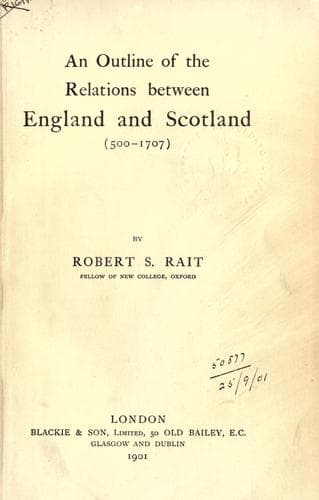
An Outline of the Relations between England and Scotland (500-1707)Rait, Robert S. (Robert Sangster)
History
An Outline of the Relations between England and Scotland (500-1707)
Rait, Robert S. (Robert Sangster)
England -- Foreign relations -- Scotland; Scotland -- Foreign relations -- England
The troublous reign of James I gave him but little time for conducting a
foreign war, and the truce which was made when the king was ransomed
continued till 1433. It had been suggested that the peace between
England and Scotland should extend to the Scottish troops serving in
France, but no such clause was inserted in the actual arrangement made,
and it is almost certain that James could not have enforced it, even had
he wished to do so. He gave, however, no indication of holding lightly
the ties that bound Scotland to France, and, in 1428, agreed to the
marriage of his infant daughter, Margaret, to the dauphin. Meanwhile,
the Scottish levies had been taking their full share in the struggle for
freedom in which France was engaged. At Crevant, near Auxerre, in July,
1423, the Earl of Buchan, now Constable of France, was defeated by
Salisbury, and, thirteen months later, Buchan and the Earl of Douglas
(Duke of Touraine) fell on the disastrous field of Verneuil. At the
Battle of the Herrings (an attack upon a French convoy carrying Lenten
food to the besiegers of Orleans, made near Janville, in February,
1429), the Scots, under the new constable, Sir John Stewart of Darnley,
committed the old error of Halidon and Homildon, and their impetuous
valour could not avail against the English archers. They shared in the
victory of Pathay, gained by the Maid of Orleans in June 1429, almost on
the anniversary of Bannockburn, and they continued to follow the Maid
through the last fateful months of her warfare. So great a part had
Scotsmen taken in the French wars that, on the expiry of the truce in
1433, the English offered to restore not only Roxburgh but also Berwick
to Scotland. But the French alliance was destined to endure for more
than another century, and James declined, thus bringing about a slight
resuscitation of warlike operations. The Scots won a victory at
Piperden, near Berwick, in 1435 or 1436, and in the summer of 1436, when
the Princess Margaret was on her way to France to enter into her
ill-starred union with the dauphin, the English made an attempt to take
her captive. James replied by an attempt upon Roxburgh, but gave it up
without having accomplished anything, and returned to spend his last
Christmas at Perth. His twelve years in Scotland had been mainly
occupied in attempts to reduce his rebellious subjects, especially in
the Highlands, to obedience and loyalty, and he had roused much
implacable resentment. So the poet-king was murdered at Perth in
February, 1436-37, and his English widow was left to guard her son, the
child sovereign, now in his seventh year. It was probably under her
influence that a truce of nine years was made.
Public-domain text, read in full here on John Shaqi.
Reviews
Reviews
No reviews yet
Be the first to share your thoughts on this work.
Elsewhere in the archive
Join the Discussion
Join the discussion
Sign in to leave a comment or review.
Sign InorCreate an account