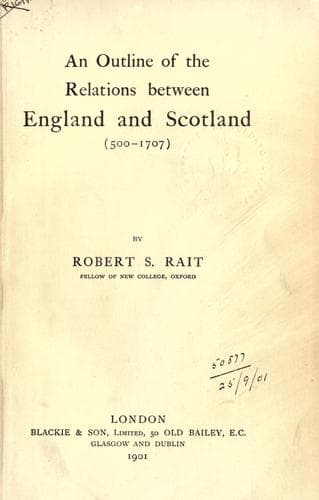
An Outline of the Relations between England and Scotland (500-1707)Rait, Robert S. (Robert Sangster)
History
An Outline of the Relations between England and Scotland (500-1707)
Rait, Robert S. (Robert Sangster)
England -- Foreign relations -- Scotland; Scotland -- Foreign relations -- England
When the truce came to an end, Scotland was in the interval between the
two contests with the House of Douglas which mark the reign of James II.
William the sixth earl and his brother David had been entrapped and
beheaded by the governors of the boy king in November, 1440, and the
new earl, James the Gross, died in 1443, and was succeeded by his son,
William, the eighth earl, who remained for some years on good terms with
the king. Accordingly, we find that, when the English burned the town of
Dunbar in May, 1448, Douglas replied, in the following month, by sacking
Alnwick. Retaliation came in the shape of an assault upon Dumfries in
the end of June, and the Scots, with Douglas at their head, burned
Warkworth in July. The successive attacks on Alnwick and Warkworth
roused the Percies to a greater effort, and, in October, they invaded
Scotland, and were defeated at the battle of Sark or Lochmaben
Stone.[56] In 1449 the Franco-Scottish League was strengthened by the
marriage of King James to Marie of Gueldres.
Now began the second struggle with the Douglases. Their great
possessions, their rights as Wardens of the Marches, their prestige in
Scottish history made them dangerous subjects for a weak royal house.
Since the death of the good Lord James their loyalty to the kings of
Scotland had not been unbroken, and it is probable that their
suppression was inevitable in the interests of a strong central
government. But the perfidy with which James, with his own hand,
murdered the Earl, in February, 1451-52, can scarcely be condoned, and
it has created a sympathy for the Douglases which their history scarcely
merits. James had now entered upon a decisive struggle with the great
House, which a temporary reconciliation with the new earl, in 1453, only
served to prolong. The quarrel is interesting for our purpose because it
largely decided the relations between Scotland and the rival lines of
Lancaster and York. In 1455, when the Douglases were finally suppressed
and their estates were forfeited, the Yorkists first took up arms
against Henry VI. Douglas had attempted intrigues with the Lord of the
Isles, with the Lancastrians, and with the Yorkists in turn, and, about
1454, he came to an understanding with the Duke of York. We find,
therefore, during the years which followed the first battle of St.
Albans, a revival of active hostilities with England. In 1456, James
invaded England and harried Northumberland in the interests of the
Lancastrians. During the temporary loss of power by the Duke of York, in
1457, a truce was concluded, but it was broken after the reconciliation
of York to Henry VI in 1458, and when the battle of Northampton, in
July, 1460, left the Yorkists again triumphant, James marched to attempt
the recovery of Roxburgh.[57] James I, as we have seen, had abandoned
the siege of Roxburgh Castle only to go to his death; his son found his
death while attempting the same task. On Sunday, the 3rd of August,
Public-domain text, read in full here on John Shaqi.
Reviews
Reviews
No reviews yet
Be the first to share your thoughts on this work.
Elsewhere in the archive
Join the Discussion
Join the discussion
Sign in to leave a comment or review.
Sign InorCreate an account