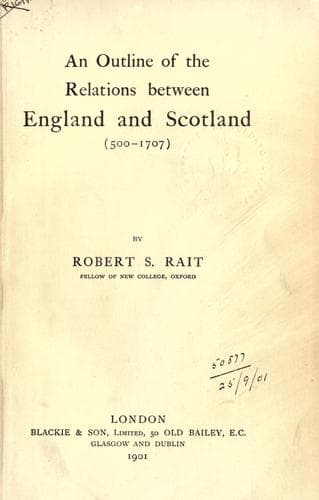
An Outline of the Relations between England and Scotland (500-1707)Rait, Robert S. (Robert Sangster)
History
An Outline of the Relations between England and Scotland (500-1707)
Rait, Robert S. (Robert Sangster)
England -- Foreign relations -- Scotland; Scotland -- Foreign relations -- England
the Firth of Forth, in revenge for a border raid for which James had
attempted to apologize. Edward was unable to secure the services of his
old ally, the Lord of the Isles, who had been again brought into
subjection in the interval of peace, and who now joined in the national
preparations for war with England. But there was still a rebel Earl of
Douglas with whom to plot, and Edward was fortunate in obtaining the
co-operation of the Duke of Albany, brother of James III, who had been
exiled in 1479. Albany and Edward made a treaty in 1482, in which the
former styled himself "Alexander, King of Scotland", and promised to do
homage to Edward when he should obtain his throne. The only important
events of the war are the recapture of Berwick, in August, 1482, and an
invasion of Scotland by the Duke of Gloucester. Berwick was never again
in Scottish hands. Albany was unable to carry out the revolution
contemplated in his treaty with Edward IV; but he was reinstated, and
became for three months Lieutenant-General of the Realm of Scotland. In
March, 1482-83, he resigned this office, and, after a brief interval, in
which he was reconciled to King James, was again forfeited in July,
1483. Edward IV had died on the 9th of April, and Albany was unable to
obtain any English aid. Along with the Earl of Douglas he made an
attempt upon Scotland, but was defeated at Lochmaben in July, 1484.
Thereafter, both he and his ally pass out of the story: Douglas died a
prisoner in 1488; Albany escaped to France, where he was killed at a
tournament in 1485; he left a son who was to take a great part in
Scottish politics during the minority of James V.
Richard III found sufficient difficulty in governing England to prevent
his desiring to continue unfriendly relations with Scotland, and he
made, on his accession, something like a cordial peace with James III.
It was arranged that James, now a widower,[58] should marry Elizabeth
Woodville, widow of Edward IV, and that his heir, Prince James, should
marry a daughter of the Duke of Suffolk. James did not afford Richard
any assistance in 1485, and after the battle of Bosworth he remained on
friendly terms with Henry VII. A controversy about Berwick prevented the
completion of negotiations for marriage alliances, but friendly
relations were maintained till the revolution of 1488, in which James
III lost his life. Both James and his rebellious nobles, who had
proclaimed his son as king, attempted to obtain English assistance, but
it was given to neither side.
Public-domain text, read in full here on John Shaqi.
Reviews
Reviews
No reviews yet
Be the first to share your thoughts on this work.
Elsewhere in the archive
Join the Discussion
Join the discussion
Sign in to leave a comment or review.
Sign InorCreate an account