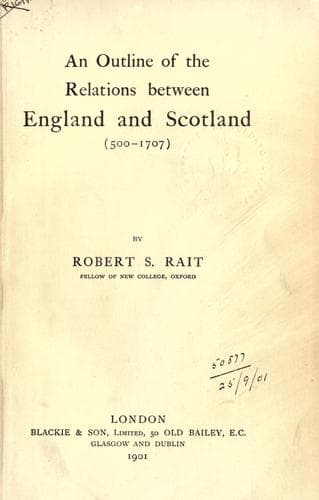
An Outline of the Relations between England and Scotland (500-1707)Rait, Robert S. (Robert Sangster)
History
An Outline of the Relations between England and Scotland (500-1707)
Rait, Robert S. (Robert Sangster)
England -- Foreign relations -- Scotland; Scotland -- Foreign relations -- England
1460, he was killed by the bursting of a cannon, the mechanism of which
had attracted his attention and made him, according to Pitscottie, "more
curious than became him or the majesty of a king".
The year 1461 saw Edward IV placed on his uneasy throne, and a boy of
ten years reigning over the turbulent kingdom of Scotland. The Scots had
regained Roxburgh a few days after the death of King James, and they
followed up their success by the capture of Wark. But a greater triumph
was in store. When Margaret of Anjou, after rescuing her husband, Henry
VI, at the second battle of St. Albans, in February, 1461, met, in
March, the great disaster of Towton, she fled with Henry to Scotland,
where she had been received when preparing for the expedition which had
proved so unfortunate. On her second visit she brought with her the
surrender of Berwick, which, in April, 1461, became once more a Scots
town, and was represented in the Parliament which met in 1469. In
gratitude for the gift, the Scots made an invasion of England in June,
1461, and besieged Carlisle, but were forced to retire without having
afforded any real assistance to the Lancastrian cause. There was now a
division of opinion in Scotland with regard to supporting the
Lancastrian cause. The policy of the late king was maintained by the
great Bishop Kennedy, who himself entertained Henry VI in the Castle of
St. Andrews. But the queen-mother, Mary of Gueldres, was a niece of the
Duke of Burgundy, and was, through his influence, persuaded to go over
to the side of the White Rose. While Edward IV remained on unfriendly
terms with Louis XI of France, Kennedy had not much difficulty in
resisting the Yorkist proclivities of the queen-mother, and in keeping
Scotland loyal to the Red Rose. They were able to render their allies
but little assistance, and their opposition gave the astute Edward IV an
opportunity of intrigue. John of the Isles took advantage of the
minority of James III to break the peace into which he had been brought
by James II, and the exiled Earl of Douglas concluded an agreement
between the Lord of the Isles and the King of England. But when, in
October, 1463, Edward IV came to terms with Louis XI, Bishop Kennedy was
willing to join Mary of Gueldres in deserting the doomed House of
Lancaster. Mary did not live to see the success of her policy; but peace
was made for a period of fifteen years, and Scotland had no share in the
brief Lancastrian restoration of 1470. The threatening relations between
England and France nearly led to a rupture in 1473, but the result was
only to strengthen the agreement, and it was arranged that the infant
heir of James III should marry the Princess Cecilia, Edward's daughter.
In 1479-80, when the French were again alarmed by the diplomacy of
Edward IV, we find an outbreak of hostilities, the precise cause of
which is somewhat obscure. It is certain that Edward made no effort to
preserve the peace, and he sent, in 1481, a fleet to attack the towns on
Public-domain text, read in full here on John Shaqi.
Reviews
Reviews
No reviews yet
Be the first to share your thoughts on this work.
Elsewhere in the archive
Join the Discussion
Join the discussion
Sign in to leave a comment or review.
Sign InorCreate an account