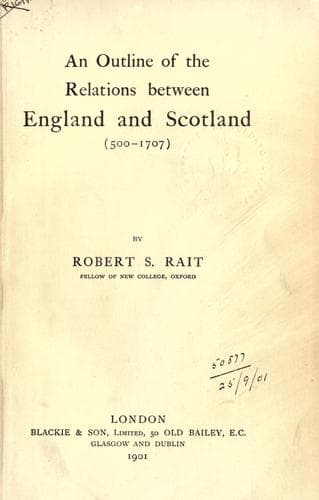
An Outline of the Relations between England and Scotland (500-1707)Rait, Robert S. (Robert Sangster)
History
An Outline of the Relations between England and Scotland (500-1707)
Rait, Robert S. (Robert Sangster)
England -- Foreign relations -- Scotland; Scotland -- Foreign relations -- England
On the 11th June, 1560, Mary died. The wisdom of the
policy of her later years may be questioned, but her conduct during her
widowhood forms a strange contrast to that of her Tudor mother-in-law in
similar circumstances. It is probable that her intentions were honest
enough, and that the Protestant indignation at her "falsehoods" was
based on invincible misunderstanding. Her gracious charm of manner was
the concomitant of a tolerance rare in the sixteenth century; and she
died at peace with all men, and surrounded by those who had been in arms
against her, receiving "all her nobles with all pleasure, with a
pleasant countenance, and even embracing them with a kiss of love".
Her death set the lords of the congregation free to carry out their
ecclesiastical programme. In August Roman Catholicism was abolished by
the Scottish Parliament and the celebration of the mass forbidden, under
severe penalties. There remained the question of the ratification of the
Treaty of Edinburgh, the final form of the agreement by which peace had
been made. The young Queen of Scots objected to the treaty on the ground
that it included a clause that "the most Christian King and Queen Mary,
and each of them, abstain henceforth from using the title and bearing
the arms of the kingdom of England or of Ireland".[61] She interpreted
the word "henceforth" as involving an absolute renunciation of her claim
to the English throne, and so prejudicing her succession, should she
survive Elizabeth. Cecil had suggested to the Scots that it might be
advisable to raise the claim of the Lord James Stewart, an illegitimate
son of James V, and afterwards Earl of Moray, to the throne, or to
support that of the House of Hamilton. The Scots improved on this
suggestion, and proposed that Elizabeth should marry the Earl of Arran,
the eldest son of the Duke of Chatelherault, who might succeed to the
throne. There were many reasons why Elizabeth should not wed the
imbecile Arran, and it may safely be said that she never seriously
considered the project although she continued to trifle with the
suggestion, which formed a useful form of intrigue against Mary.
Public-domain text, read in full here on John Shaqi.
Reviews
Reviews
No reviews yet
Be the first to share your thoughts on this work.
Elsewhere in the archive
Join the Discussion
Join the discussion
Sign in to leave a comment or review.
Sign InorCreate an account