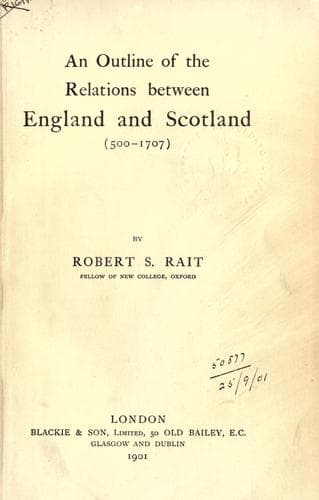
An Outline of the Relations between England and Scotland (500-1707)Rait, Robert S. (Robert Sangster)
History
An Outline of the Relations between England and Scotland (500-1707)
Rait, Robert S. (Robert Sangster)
England -- Foreign relations -- Scotland; Scotland -- Foreign relations -- England
The situation was considerably altered by the death of Francis II, in
December, 1560. That event was, on the whole, welcome to Elizabeth, for
it destroyed the power of the Guises, and Mary Stuart[62] had now to
face her Scottish difficulties without French aid. She was not on good
terms with her mother-in-law, Catherine de Medici, who now controlled
the destinies of France, and it was evident that she must accept the
fact of the Scottish Reformation, and enter upon a conflict with the
theocratic tendencies of the Church and with the Scottish nobles who
were the pensioners of Elizabeth. On the other hand, although Francis II
was dead, his widow survived, young, beautiful, charming, and a queen.
The dissolution of her first marriage had removed an actual difficulty
from the path of the English queen, but, after all, it only meant that
she might be able to contract an alliance still more dangerous. As early
as December 31st, 1560, Throckmorton warned Elizabeth that she must
"have an eye to" the second marriage of Mary Stuart.[63] The Queen of
England had a choice of alternatives. She might prosecute the intrigue
with the Earl of Arran, capture Mary on her way to Scotland, and boldly
adopt the position of the leader of Protestantism. There were, however,
many difficulties, ecclesiastical, foreign, and personal, in such a
course. Arran was an impossible husband; Knox and the lords of the
congregation made good allies but bad subjects; and the inevitable
struggle with Spain would be precipitated. The other course was to
attempt to win Mary's confidence, and to prevent her from contracting an
alliance with the Hapsburgs, which was probably what Elizabeth most
feared. This was the alternative finally adopted by the Queen of
England; but, very characteristically, she did not immediately abandon
the other possibility. On the pretext that Mary refused to confirm the
Treaty of Edinburgh, her cousin declined to grant her request for a
safe-conduct from France to Scotland, and spoke of the Scottish queen in
terms which Mary took the first opportunity of resenting. "The queen,
your mistress," she remarked to the English ambassador who brought the
refusal, "doth say that I am young and do lack experience. Indeed I
confess I am younger than she is, and do want experience; but I have age
enough and experience to use myself towards my friends and kinsfolk
friendly and uprightly; and I trust my discretion shall not so fail me
that my passion shall move me to use other language of her than it
becometh of a queen and my next kinswoman."[64]
Public-domain text, read in full here on John Shaqi.
Reviews
Reviews
No reviews yet
Be the first to share your thoughts on this work.
Elsewhere in the archive
Join the Discussion
Join the discussion
Sign in to leave a comment or review.
Sign InorCreate an account