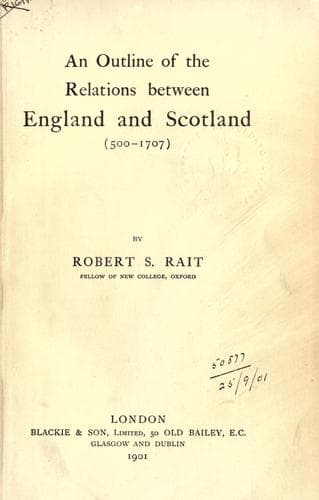
An Outline of the Relations between England and Scotland (500-1707)Rait, Robert S. (Robert Sangster)
History
An Outline of the Relations between England and Scotland (500-1707)
Rait, Robert S. (Robert Sangster)
England -- Foreign relations -- Scotland; Scotland -- Foreign relations -- England
When, in August, 1561, Mary did sail from France to Scotland, Elizabeth
made an effort to capture her. It was characteristically hesitating, and
it succeeded only in giving Mary an impression of Elizabeth's hostility.
Some months later Elizabeth imprisoned the Countess of Lennox, the
mother of Darnley, for giving God thanks because "when the queen's
ships were almost near taking of the Scottish queen, there fell down a
mist from heaven that separated them and preserved her".[65] The arrival
of Mary in Scotland effectually put an end to the Arran intrigue, but
the girl-widow of scarcely nineteen years had many difficulties with
which to contend. As a devout Roman Catholic, she had to face the
relentless opposition of Knox and the congregation, who objected even to
her private exercise of her own faith. As the representative of the
French alliance, now but a dead cause, she was confronted by an English
party which included not only her avowed enemies but many of her real or
pretended friends. Her brother, the Lord James Stewart, whom she made
Earl of Moray, and who guided the early policy of her reign, was
constantly in Elizabeth's pay, as were most of her other advisers. Her
secretary, Maitland of Lethington, the most distinguished and the ablest
Scottish statesman of his day, had, as the fixed aim of his policy, a
good understanding with England. Furthermore, she was disliked by all
the nobles who had seized upon the property of the Church and added it
to their own possessions. Up to the age of twenty-five she had, by Scots
law, the right of recalling all grants of land made during her minority,
and her greedy nobles knew well that the victory of Roman Catholicism
meant the restoration of Church lands. Her relations with France were
uncertain, and the Guises found their attention fully occupied at home.
As the next heir to the throne of England, she was bound to be very
careful in her dealings with Elizabeth. United by every tie of blood and
sentiment to Rome and the Guises, she was forced, for reasons of policy,
to remain on good terms with Protestantism and the Tudor Queen of
England. The first years of Mary's reign in Scotland were marked by the
continuance of good relations between herself and her half-brother, whom
she entrusted with the government of the kingdom. In 1562 she suppressed
the most powerful Catholic noble in Scotland, the Earl of Huntly. The
result of this policy was to raise an unfounded suspicion in England and
Spain that the Queen of Scots was "no more devout towards Rome than for
the sustentation of her uncles".[66] The indignation felt at Mary's
conduct among Roman Catholics in England and in Spain may have been one
of the reasons for Elizabeth's adopting a more distinctly Protestant
position in 1562. In the Act of Supremacy of that year the first avowed
reference is made to the authority used by Henry VIII and Edward VI,
_i.e._ the Supreme Headship of the Church. It at all events made
Public-domain text, read in full here on John Shaqi.
Reviews
Reviews
No reviews yet
Be the first to share your thoughts on this work.
Elsewhere in the archive
Join the Discussion
Join the discussion
Sign in to leave a comment or review.
Sign InorCreate an account