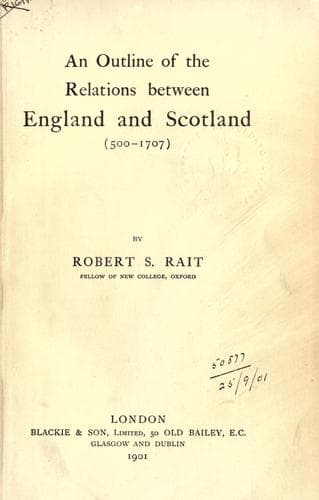
An Outline of the Relations between England and Scotland (500-1707)Rait, Robert S. (Robert Sangster)
History
An Outline of the Relations between England and Scotland (500-1707)
Rait, Robert S. (Robert Sangster)
England -- Foreign relations -- Scotland; Scotland -- Foreign relations -- England
policy of making grants of land in Moray, and this is probably the germ
of truth in Fordun's statement. Moray, however, occupied rather an
exceptional position. "As the power of the sovereign extended over the
west," says Mr. E.W. Robertson, "it was his policy, not to eradicate the
old ruling families, but to retain them in their native provinces,
rendering them more or less responsible for all that portion of their
respective districts which was not placed under the immediate authority
of the royal sheriffs or baillies." As this policy was carried out even
in Galloway, Argyll, and Ross, where there were occasional rebellions,
and was successful in its results, we have no reason for believing that
it was abandoned in dealing with the rest of the Lowlands. As, from time
to time, instances occurred in which this plan was unsuccessful, and as
other causes for forfeiture arose, the lands were granted to strangers,
and by the end of the thirteenth century the Scottish nobility was
largely Anglo-Norman. The vestiges of the clan system which remained may
be part of the explanation of the place of the great Houses in Scottish
History. The unique importance of such families as the Douglasses or the
Gordons may thus be a portion of the Celtic heritage of the Lowlands.
If, then, it was not by a displacement of race, but through the subtle
influences of religion, feudalism, and commerce that the Scottish
Lowlands came to be English in speech and in civilization, if the
farmers of Fife and some, at least, of the burghers of Dundee or of
Aberdeen were really Scots who had been subjected to English influences,
we should expect to find no strong racial feeling in mediaeval Scotland.
Such racial antagonism as existed would, in this case, be owing to the
large admixture of Scandinavian blood in Caithness and in the Isles,
rather than to any difference between the true Scots and "the English
of the Lowlands". Do we, then, find any racial antagonism between the
Highlands and the Lowlands? If Mr. Freeman is right in laying down the
general rule that "the true Scots, out of hatred to the 'Saxons' nearest
to them, leagued with the 'Saxons' farther off", if Mr. Hill Burton is
correct in describing the red Harlaw as a battle between foes who could
have no feeling of common nationality, there is nothing to be said in
support of the theory we have ventured to suggest. We may fairly expect
some signs of ill-will between those who maintained the Celtic
civilization and their brethren who had abandoned the ancient customs
and the ancient tongue; we may naturally look for attempts to produce a
conservative or Celtic reaction, but anything more than this will be
fatal to our case. The facts do not seem to us to bear out Mr. Freeman's
generalization. When the independence of Scotland is really at stake, we
shall find the "true Scots" on the patriotic side. Highlanders and
Islesmen fought under the banner of David I at Northallerton; they took
Public-domain text, read in full here on John Shaqi.
Reviews
Reviews
No reviews yet
Be the first to share your thoughts on this work.
Join the Discussion
Join the discussion
Sign in to leave a comment or review.
Sign InorCreate an account