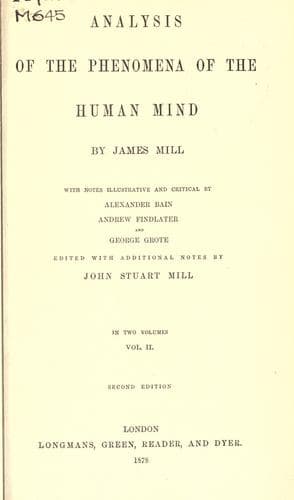
Analysis of the Phenomena of the Human MindMill, James
PhilosophyPhilosophy
Analysis of the Phenomena of the Human Mind
Mill, James
Psychology
Almost all the advantages, which man possesses above the inferior
animals, arise from his power of acting in combination with his
fellows; and of accomplishing, by the united efforts of numbers,
what could {129} not be accomplished by the detached efforts of
individuals. Without the power of communicating to one another their
sensations and ideas, this co-operation would be impossible. The
importance, therefore, of the invention of signs, or marks, by which
alone that communication can be effected, is obvious.
Among sensible objects, those alone which are addressed to the
senses of seeing and hearing have sufficient precision and variety
to be adapted to this end. The language of Action, as it has been
called, that is, certain gesticulations and motions, has very
generally, especially among rude people, whose spoken language is
scanty, been found in use to indicate certain states, generally
complicated states, of mind. But, for precision, variety, and
rapidity, the flexibility of the voice presented such obvious
advantages, not to mention that visible signs must be altogether
useless in the dark, that sounds, among all the varieties of our
species, have been assumed as the principal medium by which their
sensations and ideas were made known to one another.
There can be little doubt that, of the two uses of marks,
Communicating our thoughts, and Recording them, the advantage of the
first would be the earliest felt; and that signs for Communicating
would be long invented, before any person would see the advantage of
Recording his thoughts. After the use of signs for Communication had
become familiar, it would not fail, in time, to appear that signs
might be employed for Recordation also; and that, from this use of
them, the highest advantages might be derived.
In respect to those advantages, the following particulars are to be
observed.
{130} 1. We cannot recall any idea, or train of ideas, at will.
Thoughts come into the mind unbidden. If they did not come unbidden,
they must have been in the mind before they came into it; which is a
contradiction. You cannot bid a thought come into the mind, without
knowing that which you bid; but to know a thought is to have the
thought: the knowledge of the thought, and the thought's being in
the mind, are not two things but one and the same thing, under
different names.
If we cannot recall at pleasure a single idea, we are not less
unable to recall a train. Every person knows how evanescent his
thoughts are, and how impossible it is for him to begin at the
beginning of a past train, if it is not a train of the individual
objects familiar to his senses, and go on to the end, neither
leaving out any of the items which composed it, nor allowing any
which did not belong to it, to enter in.
Public-domain text, read in full here on John Shaqi.
Reviews
Reviews
No reviews yet
Be the first to share your thoughts on this work.
Elsewhere in the archive
Join the Discussion
Join the discussion
Sign in to leave a comment or review.
Sign InorCreate an account