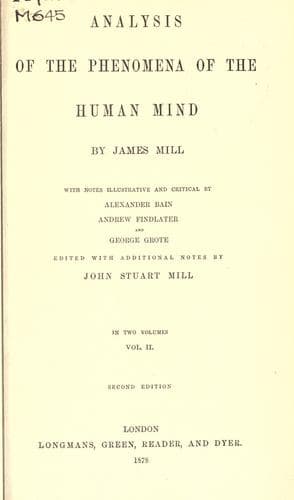
Analysis of the Phenomena of the Human MindMill, James
PhilosophyPhilosophy
Analysis of the Phenomena of the Human Mind
Mill, James
Psychology
"I endeavour, as much as I can, to deliver myself from those
fallacies which we are apt to put upon ourselves, by taking words
for things. It helps not our ignorance to feign a knowledge where we
have none, by making a noise with sounds without clear and distinct
significations. Names made at pleasure, neither alter the nature of
things, nor make us understand them, but as they are signs of, and
stand for, determined ideas."--_Locke, Hum. Und._ b. ii. ch. 13, §
18.
WE have now surveyed the more simple and obvious phenomena of the
human mind. We have seen, first, that we have SENSATIONS; secondly,
that we have IDEAS, the copies of those sensations; thirdly, that
those ideas are sometimes SIMPLE, the copies of one sensation;
sometimes COMPLEX, the copies of several sensations so combined as
to appear not several ideas, but one idea; and, fourthly, that we
have TRAINS of those ideas, or one succeeding another without end.
These are simple facts of our nature, attested by experience; and my
chief object in fixing upon them the attention of the reader has
been, to convey to him that accurate and steady conception of them,
which is requisite for the successful prosecution of the subsequent
inquiries.
{128} After delineating the simple and elementary states of
consciousness, it follows, in order, that we should endeavour to
show what is contained in those that are complex. But in all the
more complicated cases of human consciousness something of the
process of Naming is involved. These cases, of course, cannot be
unfolded, till the artifice of Naming is made known. This,
therefore, is necessarily an intermediate inquiry; and one to which
it is necessary that we should devote a particular degree of
attention.
There are two purposes, both of great importance, for which marks of
our ideas, and sensations; or signs by which they may be denoted;
are necessary. One of these purposes is, That we maybe able to make
known to others what passes within us. The other is, That we may
secure to ourselves the knowledge of what at any preceding time has
passed in our minds.
The sensations and ideas of one man are hidden from all other men;
unless they have recourse to some expedient for disclosing them. We
cannot convey to another man our sensations and ideas directly. Our
means of intercourse with other men are through their senses
exclusively. We must therefore choose some SENSIBLE OBJECTS, as
SIGNS of our inward feelings. If two men agree, that each shall use
a certain sensible sign, when one of them means to make known to the
other that he has a certain sensation, or idea, they, in this, and
in no other way, can communicate a knowledge of those feelings to
one another.
Public-domain text, read in full here on John Shaqi.
Reviews
Reviews
No reviews yet
Be the first to share your thoughts on this work.
Elsewhere in the archive
Join the Discussion
Join the discussion
Sign in to leave a comment or review.
Sign InorCreate an account